“天淨沙”: 秋思 (元) 馬致遠

In the tune of "Pristine Sand under Heaven": Fall Meditation
by Ma Zhiyuan (1250-1321)

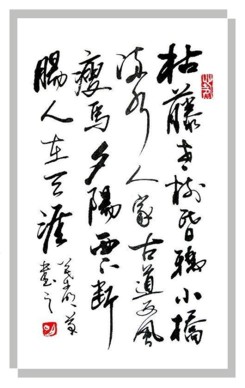
枯藤老树昏鸦,

小桥流水人家;

古道西风瘦马,

夕阳西下,

断肠人在天涯!

Tr. YK Chan  陈耀国译
On a wilted vine, on an old tree, at dusk a crow roosts.
A quaint footbridge, water running under, crosses over to a homestead.
On an ancient trail westerly wind blows while a gaunt horse wanders.
Sun setting west,
The heart-broken is lost on the edge of heaven.

《峨眉山月歌》__ 李白 (701-762)

峨眉山月半輪秋
影入平羌江水流
夜發清溪向三峡
思君不見下渝州

Song of Moon O’er Mt. O Mei                        Li Bai (701-762)         江紹倫譯

The moon o’er Mt. O Mei appears like autumn’s golden brow
She casts fancy shadows on the meandering river as it quietly flows
I will set out from Clear Stream for the Three Gorges tonight
How I miss you when the tall cliffs keep you out of my sight

《獨坐敬亭山》__李白 (701-762)

眾鳥高飛盡
孤雲獨去閑
相看兩不厭
只有敬亭山

Watching Jingting Peak in Solitude  Li Bai (701-762)         江紹倫譯

Birds stop before reaching your majestic peak so high
Solitary clouds drift over you free and nigh
Where I can tirelessly watch birds and clouds the wonderful view
Here when I’m sitting in front of you

愛車之情

(Through Rose-Coloured Glasses)

北美人愛車如命。

在加拿大, 地大人少, 出門都要以車代歩。如果要靠两條腿走路, 大半天也不能走到; 乘搭巴士, 一等就是半個鐘頭, 又要轉車數次, 很是麻煩。汽車巳是北美生活的必需公具。

北美人 (尤其是男任們) 談到汽車, 卻又眉飛色舞, 列舉各種名牌車, 如數家珍; 由引擎的各種汔缸, 到馬力的勁差, 再加上各類車呔, 汽車新歷聲, 都是津津有味。嚴然又是另一種文化。

每到周末, 總得花上半天時間, 把汽車內外, 洗刷乾淨, 再重新打蠟。愛護之情, 比自家孩子, 有過之而無不及。

但另方面, 有一奇怪現象, 又令我百思不得其解。

拿我家附近一區来説, 全是獨立房屋, 各家都有两個車房; 但到了晚上, 每家門前就停放了两三輛車, 棄車房而不用。

長年累月, 汔車是丢在外邊, 在屋前通道, 甚至在街上, 日曬雨淋, 下雪時更被埋在雪堆。

在一些天氣寒冷的城市, 在嚴冬時, 汔車引擎還要插電保暖, 才可保正能啟動發動機, 但汽車還是停放在外邊。

拉開車房門一看, 都堆滿了傢俬雜物, 變成為一個額外儲物室。

朋友花了數千元購買了一隻小型摩打艇, 打算夏天出海鈎魚, 游泳。也把艇放進車房, 而其名牌座架車卻停放屋外, 吸收日月精華。

笑問: 汽車, 小艇, 究竟那樣昂貴!?

钗頭鳳 陸遊 (1125-1210);唐琬 (1124-1156)

钗頭鳳           陸遊 (1125-1210)

紅酥手      黃藤酒
滿城春色宮牆柳
東風惡      歡情薄
一懷愁緒    幾年離索
錯    錯    錯

春如舊      人空瘦
淚痕紅邑鲛绡透
桃花落      閑池閣
山盟雖在    錦書難托
莫    莫    莫

Tune: Phoenix Hairpin                       Lu You (1125-1210) 江紹倫譯

Tender hands fine
Well aged wine
In a spring-filled city willows confined
Harsh east winds
Happy feelings thin
My heart filled with misery
Yearnings years too long
Wrong Wrong Wrong

Spring like last year remains
I see you are so thin
Your red kerchief soaked with tears
Peach blossoms fall
By the deserted hall
Our love oaths still true
Messages could not get through
No  No  No

(We know very little about marriages in old times. They were ruled by parents for sure, but not entirely. Lu You divorced his dear wife Tang Wan by his mother’s demand. They met two years later when they were still very much in love. But they were already remarried by then. Those were days when poets were free to write poems on public walls, like graffiti’s today. Lu wrote the first poem. Tang saw it and wrote the second in reply.)

钗頭鳳           唐琬 (1124-1156)

世情薄      人情惡
雨送黃昏花易落
曉風乾      淚痕殘
欲箋心事    獨語斜闌
難    難    難

人成各      今非昨
病魂常似秋千索
角聲寒      夜闌珊
怕人尋問    咽淚妝歡
瞞    瞞    瞞  

Tune: Phoenix Hairpin           Tang Wan (1124-1156)  江紹倫譯

Fairness has worn thin
Relations belligerent
Rain-filled eves hasten flowers to fall
Morning breezes fuss
Traces of tears fade
I wish to write you my feelings
Only to lean on rails alone
Hard  Hard  Hard

You and I have gone different ways
‘Tis no more like yesterday
Hanging tight my injured soul continues to groan
Time-horns their frigid notes blow
Nights persist refusing to grow old
To dispel any query
Tears swallowed I appear cheery
Hide  Hide  Hide

摸魚兒 辛棄疾 (1140-1207)

(淳熙己亥,自湖北漕移湖南,同官王正之置酒小山亭,為賦)

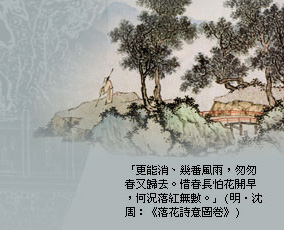
更能消      幾番風雨    匆匆春又歸去
惜春長怕花開早    何況落紅無數
春且住      見說道      天涯芳草無歸路
怨春不語    算隻有殷勤  畫檐蛛網    鎮日惹飛絮

長門事      準拟佳期又誤      蛾眉曾有人妒
千金縱買相如賦    脈脈此情誰訴
君莫舞      君不見      玉環飛燕皆塵土
閑愁最苦    休去倚危欄  斜陽正在    煙柳斷腸處

Tune: Catching Fish   Xin Qi Ji (1140-1207) 江紹倫譯

(On transfer from Hubei to Hunan I wrote this as Wang Cheng Zhi feasted me)

How much more wind and rain can spring uphold
As it must forthwith recede when old
Lovers of spring are concerned seeing buds in hurry bloom
For early flowers usually shed their red petal too soon
Spring O Spring stay
I’ve often heard people say
Sweet grass roaming wide are doomed to go astray
Silently spring remains
When busy spiders weave webs on painted eaves day by day
To catch willow downs before they are blown away

What could a consort do
As nuptial dates are foregone when due
A favoured beauty will turn envy eyes naturally
Even if love could be bought by songs readily
To whom could she complain this overlooked affection
Keep your dance stationed
You must have seen
How beauties fat and slim to dust they turned in
Unjust sorrows are bitterest to swallow
Where the sun sets heart-broken are the willows

酬樂天揚州初逢席上見贈 劉禹錫(772-842)

巴山楚水淒涼地
二十三年棄置身
懷舊空吟聞笛賦
到鄉翻似爛柯人
沉舟側畔千帆過
病樹前頭萬木春
今日聽君歌一曲
暫憑杯酒長精神

Echoing Bai Ju Yi on Our First Meeting       Liu Yu Xi (772-842) 江紹倫譯

The south-west mountain and river region is desolation
Where in exile for twenty-three years I had lived in isolation
To mourn for departed friends I croon hearing but bamboo cries
On native land I existed like caste debris
A thousand sails had passed this sunken ship by
Ten thousand flowers had bloomed around this injured tree
As I hear you chant this comradeship melody today
I raise this cup to wish our good spirit will forever stay

“Habanera” Henri Meilhac (1831 – 97) & Ludovic Halévy (1834 – 1908)

哈巴湼拉舞曲     (法) 汉利.美尔压 与 路度维.亚里菲 普词

Mezzo-soprano aria from Bizet’s opera “Carmen”

比才歌剧”卡门”之女中音咏叹調

Sung by Julia Migenes-Johnson: http://www.youtube.com/watch?v=uV9iGv4sKNI

By Teresa Berganza: http://www.youtube.com/watch?v=oby-hCgZLJc&feature=related

By Maria Callas: http://www.youtube.com/watch?v=6fZRssq7UlM&NR=1

Habenera 哈巴湼拉舞

Tr. YK Chan 陈耀国译


Quand je vous aimerai?                                 我何时会爱你?

 Ma foi, je ne sais pas,                                 我的天,我怎知道。

Peut-être jamais, peut-être demain.                       可能永不,可能明天。

Mais pas aujourd’hui, c’est certain             但不是今天,这是肯定的。

 L’amour est un oiseau rebelle                       爱情是一只反叛的雀鳥

que nul ne peut apprivoiser,                           无人可馴服牠。

et c’est bien en vain qu’on l’appelle,                     牠自承拒绝的话, 

s’il lui convient de refuser.                                   你也只是空喚牠, 

Rien n’y fait, menace ou prière,              用恐吓或祈求,都无法可行。

l’un parle bien, l’autre se tait:                         口善词令者与另沈默寡言者之间

Et c’est l’autre que je préfère,                                   我喜欢另外那人,

Il n’a rien dit mais il me plaît.                            他不做声,我却喜欢他。

L’amour! L’amour! L’amour! L’amour!            爱情!爱情!爱情!爱情!

 L’amour est enfant de Bohème,                     爱情是吉卜赛孩子,

il n’a jamais, jamais connu de loi;              他永不,永不承认法规;

si tu ne m’aimes pas, je t’aime:             你若不爱我,我爱你:

si je t’aime, prends garde à toi!             你若爱我,你就要自己提防!

Si tu ne m’aimes pas,                                       你若不爱我,

Si tu ne m’aimes pas, je t’aime!             你若不爱我,我爱你!

Mais, si je t’aime,                                     但是,你若爱我,

Si je t’aime, prends garde à toi!                你若爱我,你就要自己提防!

Si tu ne m’aimes pas,                                       你若不爱我,

Si tu ne m’aimes pas, je t’aime!             你若不爱我,我爱你!

Mais, si je t’aime,                                     但是,你若爱我,

Si je t’aime, prends garde à toi!                你若爱我,你就要自己提防!

L’oiseau que tu croyais surprendre                 你以為已把那鳥兒捉住,

battit de l’aile et s’envola …                              牠就展翅飞走

l’amour est loin, tu peux l’attendre;                爱情远離,你可等待;

tu ne l’attends plus, il est là!                                你不再等待牠的话,牠就出现!

Tout autour de toi, vite, vite,                             环绕着你,快快的,快快的,

il vient, s’en va, puis il revient …                     牠來,牠去,然後牠再來…

tu crois le tenir, il t’évite,                         你以为把牠抓住,牠就逃去,

tu crois l’éviter, il te tient.                            你以为逃避了牠,牠就抓住你。

L’amour! L’amour! L’amour! L’amour!            爱情!爱情!爱情!爱情!

L’amour est enfant de Bohème,                     爱情是吉卜赛孩子,

il n’a jamais, jamais connu de loi;              他永不,永不承认法规;

si tu ne m’aimes pas, je t’aime:             你若不爱我,我爱你:

si je t’aime, prends garde à toi!        你若爱我,你就要自己提防!

竹枝詞二首 (I) 劉禹錫(772-842)

楊柳青青江水準
聞郎江上唱歌聲
東邊日出西邊雨
道是無晴卻有晴

Nineteen Bamboo Song (I)   Liu Yu Xi (772-842)  江紹倫譯

Meandering through green willows the river murmurs on
I hear you on your boat singing me a song
While the sun shines in the east the west is in rain
You my dear appears aloof but your love for me is plain

上圖書館

(Through Rose-Coloured Glasses)

第一次上圖書館, 在中學時代。中一那年, 學校剛成立了一個小型圖書室, 趁大隊走去拿了張圖書証, 還借了一本書回家。結果那本書, 一放在櫃頭就整整一年, 原封不動, 連書也沒有打開過, 到學期尾, 唯有硬着頭皮去還書, 給圖書館長教訓了一大頓, 還好, 沒有罸錢。

以後就一直再沒有踏足圖書館。到中五, 為了會考衝綫, 臨渴掘井; 但在家裏讀書, 因為天氣炎熱, 邊讀邊抹汗, 很不方便, 便又上公立圖書館, 嘆其冷氣。

上大學, 每晚都往圖書館跑, 抱着厚厚的教科書, 講義, 美其名是讀書, 趕功課, 其實花上大部份的時間, 在咖啡室和同學們打牙較。有時, 夜車開得太多, 實在太累了, 就伏在書桌上, 打起噸来。

卅多年前, 在加拿大的華人還是不多。這裡的公立圖書館對中文書並不重視, 收藏極少。有位朋友郤想出一個妙法来, 他每星期都到他附近那間圖書館, 不論是那類的中文書, 都大批地借回来, 一星期後, 連看也末看, 就拿回去還, 又從新再借一批, 周而復始。結果圖書館的記錄, 就顯示到中文圖書的借出率很高, 一定是很受歡迎; 圖書館也就撥款購置一批又一批新的中文書了。

漸漸移民多了, 對中文圖書的要求高漲, 再不需要人為的提高。各圖書館紛紛設立中文圖書部。成為我們平時閲覽中文書, 報章, 雜誌的好去處。

曾記得, 多年以前, 圖書館又有過新的妙用。有一位先生, 從美國回港, 登報誠徴女友, 先友後婚。聲明每天長駐大會堂公立圖書館, 歡迎有意的女士前来”單睇”, 看過夠飽。如合心意, 才上前應徴。

書中自有顏如玉, 此君一定是熟讀聖言書者也。