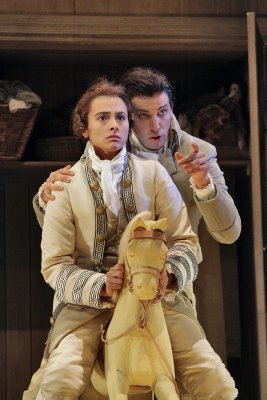
Figaro (R) & Cherubino (L)
Mozart’s baritone aria from “The Marriage of Figaro”
“你完疍了” (意) 罗兰素.达邦提 谱词
莫扎特歌剧”费加洛的婚礼”男中音咏叹調
Tr. YK Chan 陈耀国譯
Aria background: Figaro the barber [see http://blog.wykontario.org/?p=5031] has become Count Almaviva’s head servant after the Count [as “Lindoro” in “The Barber of Seville”; see http://blog.wykontario.org/?p=5084] marries Rosina. In this aria, Figaro mocks Cherubino, the Count’s teen page, who is being ordered by the Count to join the army as his punishment for constantly flirting with the females in the household. In Cherubino’s own aria “Voi che sapete” [http://blog.wykontario.org/?p=5301], we’ve seen him as a teenage boy who sings about his hot flashes of puberty.
Performed by Hermann Prey: http://www.youtube.com/watch?v=g3BthgYwbIU&feature=related
by Jose van Dam: http://www.youtube.com/watch?v=q4DzUcGQpO8&feature=related
by Ruggero Raimondi: http://www.youtube.com/watch?v=J3UCxd_KSVo&feature=related
Non più andrai, farfallone amoroso, 你完疍了,多情的浪蝶,
Notte e giorno d´intorno girando, 日与夜在室內週旋,
Delle belle turbando il riposo, 打擾少女们的安息,
Narcisetto, Adoncino d´amor. 衷於自我憐爱之情。
Delle belle turbando il riposo, 打擾少女们的安息,
Narcisetto, Adoncino d´amor. 衷於自我憐爱之情。
Non più avrai questi bei penacchini, 你不会再有那些漂亮的羽毛,
Quel cappello leggiero e galante, 那轻灵而堂皇的帽子,
Quella chioma, quell´aria brillante, 那秀发,那才华滿溢的氣派,
Quel vermiglio donnesco color! 那女人形的红光滿臉!
Quel vermiglio donnes color! 那女人形的红光滿臉!
Non più avrai quei penacchini, 你不会再有那些羽毛,
Quel cappello 那帽子
Quella chioma, quell´aria brillante! 那秀发,那才华滿溢的氣派!
Non più andrai, farfallone amoroso, 你完疍了,多情的浪蝶,
Notte e giorno d´intorno girando, 日与夜在室內週旋,
Delle belle turbando il riposo, 打擾少女们的安息,
Narcisetto, Adoncino d´amor. 衷於自我憐爱之情。
Delle belle turbando il riposo, 打擾少女们的安息,
Narcisetto, Adoncino d´amor. 衷於自我憐爱之情。
Fra guerrieri, poffar Bacco! 你要与士兵们一起,真的酒神!
Gran mustacchi, stretto sacco, 大胡子,緊背囊,
Schioppo in spalla, sciabla al fianco, 肩挑上槍,劍配在旁,
Collo dritto, jules is god, 頸要挺,臉不改容,
Un gran casco, o un gran turbante, 戴上大大的头盔,或是头巾,
Molto onor, poco contante. 荣耀多,錢财少。
Poco contante 錢财少
Poco contante 錢财少
Ed in vece del fandango 又並非跳快舞
Una marcia per il fango. 却要在泥浆上行军。
Per montagne, per valloni, 上山,下谷,
Con le nevi, e i solioni, 冒霜雪,晒暴日,
Al concerto di tromboni, 应对喇叭,
Di bombarde, di cannoni, 轟炸,响炮,
Che le palle in tutti i tuoni, 子弹橫飞如雷,
All´orecchio fan fischiar. 有如耳边的口哨般响。
Non più avrai quei penacchini, 你不会再有那些羽毛,
Non più avrai quel cappello 再沒有那帽子
Non più avrai quella chioma 再沒有那秀发
Non più avrai quell´aria brillante. 再沒有那才华滿溢的氣派!
Non più andrai, farfallone amoroso, 你完疍了,多情的浪蝶,
Notte e giorno d´intorno girando, 日与夜在室內週旋,
Delle belle turbando il riposo, 打擾少女们的安息,
Narcisetto, Adoncino d´amor. 衷於自我憐爱之情。
Delle belle turbando il riposo, 打擾少女们的安息,
Narcisetto, Adoncino d´amor. 衷於自我憐爱之情。
Cherubino, alla vittoria! 卡路賓奴,朝向胜利吧!
Alla gloria militar! 朝向军事的光荣吧!
Cherubino, alla vittoria! 卡路賓奴,朝向胜利吧!
Alla gloria militar! 朝向军事的光荣吧!
Alla gloria militar! 朝向军事的光荣吧!
Alla gloria militar! 朝向军事的光荣吧!