Là ci darem la mano 哪,给我们同拉手吧

A seductive duet sung by Zerlina (soprano) and Don Giovanni (baritone), the title role of Don Giovanni
(K. 527;complete title: Il dissoluto punito, ossia il Don Giovanni, literally The Rake Punished, or
Don Giovanni),an opera in two acts with music by Wolfgang Amadeus Mozart and with an Italian
libretto by Lorenzo Da Ponte.

In this duet, Don Giovanni targets at Zerlina (soprano, a peasant bride) in Act 1.  It is featured in the Danish film “Barbette’s Feast (1987)”.

Renditions by:

Christine Schafer & Simon Keenlyside (in concert) –

http://www.youtube.com/watch?v=ymBPo0AJ-2Y

Hei-Kyung Hong & Bryn Terfel – http://www.youtube.com/watch?v=NqPcb1nKZYg&feature=related

Renee Fleming & Dmitri Hvorostovsky (in concert) –

http://www.youtube.com/watch?v=-iZHwbxLBO0&feature=related

Dawn Upshaw & Samuel Ramey—

http://www.youtube.com/watch?v=wQ7PKtS2BR8&NR=1

Tr. YK Chan 陈耀国译

Don Giovanni
Là ci darem la mano,
Là mi dirai di si.
Vedi, non è lontano;
Partiam, ben mio, da qui. 

Zerlina
(Vorrei e non vorrei,
Mi trema un poco il cor.
Felice, è ver, sarei,
Ma può burlarmi ancor.)

Don Giovanni
Vieni, mio bel diletto!

Zerlina
(Mi fa pietà Masetto.)

Don Giovanni
Io cangierò tua sorte.

Zerlina
Presto… non son più forte.

Don Giovanni
Andiam!

Zerlina
Andiam!

A due
Andiam, andiam, mio bene.
a ristorar le pene
D’un innocente amor.

唐。吉奧凡尼
哪,给我们同手拉手吧,
哪,你就对我说”好吧”;
瞧,那並不是太遠的;
我親爱的,我们从这里走开好了。 

雪蓮娜
(我想,但又不想,
我有點兒心跳。
我会真高興,
但那也会是一种挑逗。

唐。吉奧凡尼
来, 我的可人儿!

雪蓮娜
(我怜恤马塞图)

唐。吉奧凡尼
我会改永远变你的命运

雪蓮娜
立刻…我不甚坚强

唐。吉奧凡尼

我们走吧!

雪蓮娜
我们走吧!

合唱
我们走吧, 我们走吧, 我亲爱的
去治疗那无知爱情的痛楚

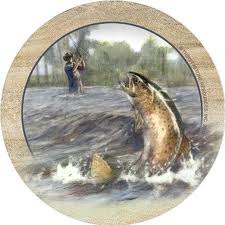
Die Forelle (The Trout 鱒魚) Christian Friedrich Daniel Schubart

Die Forelle, Op.32 (D.550), is a lively lied written in 1817 by Franz Schubert (1797-1828). This immensely popular piece is for solo voice and piano. The lyrics are from the first three (of four) stanzas of a poem by Christian Friedrich Daniel Schubart. The piece is written with a Varied Strophic structure, meaning the “verse music” is generally the same, with one different verse.  [http://en.wikipedia.org/wiki/Die_Forelle]

Renditions by –

Ian Bostridge (tenor): http://www.youtube.com/watch?v=bk-TXzUlJhs&feature=related

Hermann Prey (baritone): http://www.youtube.com/watch?v=arlDs0oebkQ&feature=related

Elisabeth Schwarzkopf (soprano): http://www.youtube.com/watch?v=s0aUdoNxEeY&feature=related

Christa Ludwig (mezzo-soprano): http://www.youtube.com/watch?v=pH611kqRLVc&feature=related

[http://en.wikipedia.org/wiki/Trout_Quintet]

 In einem Bächlein helle,
Da schoß in froher Eil
Die launische Forelle
Vorüber wie ein Pfeil.
Ich stand an dem Gestade
Und sah in süßer Ruh
Des muntern Fischleins Bade
Im klaren Bächlein zu.

Ein Fischer mit der Rute
Wohl an dem Ufer stand,
Und sah’s mit kaltem Blute,
Wie sich das Fischlein wand.
So lang dem Wasser Helle,
So dacht ich, nicht gebricht,
So fängt er die Forelle
Mit seiner Angel nicht.

Doch endlich ward dem Diebe
Die Zeit zu lang. Er macht
Das Bächlein tückisch trübe,
Und eh ich es gedacht,
So zuckte seine Rute,
Das Fischlein zappelt dran,
Und ich mit regem Blute
Sah die Betrogene an.


Die ihr am goldenen Quelle

Der sicheren Jugend weilt,

Denkt doch an die Forelle,

 Seht ihr Gefahr, so eilt!

Meist fehlt ihr nur aus Mangel

 der Klugheit, Mädchen, seht

Verführer mit der Angel!

Sonst blutet ihr zu spät!

 Tr. Walter Meyer

Across a clear brook gentle,

There shot in eager haste

The trout, so temperamental;

Quite arrow-like it raced.

I on the shore was gazing

And watched the brook disclose

The merry fish’s bathing

To me in sweet repose.

An angler’s reel unrolled

From where he stood below.

He watched with blood most cold

The fish swim to and fro.

So long no stone or sod

Stirred up the water pure

The trout from line and rod

Would stay, I thought, secure.

At length the thief lost patience

And made the brook obscure

With crafty agitations,

And ere I could be sure

The rod had started curving;

The squirming fish was hooked.

With pounding blood observing,

At the betrayed, I looked.

You, at the fountain golden,

Of youth, so free from doubt,

Be to the trout beholden;

At danger’s sign, clear out!

‘Tis oft for want of reason

That maids will shun the straight.

Beware the anglers’ treason

Else you may bleed too late!

Flower Song “La fleur que tu m’avais jetée”, libretto by Henri Meilhac & Ludovic Halévy

from Bizet’s opera Carmen

Franco Corelli as Don Jose'

() 比才之歌剧<卡门>男高音咏叹調<你扔给我的花>

Tenor aria from Carmen, a French opéra comique by Georges Bizet. The libretto is by Henri Meilhac and Ludovic Halévy, based on the novella of the same title by Prosper Mérimée, first published in 1845, itself possibly influenced by the narrative poem The Gypsies (1824) by Alexander Pushkin普希金.Mérimée had read the poem in Russian by 1840 and translated it into French in 1852. [Source: http://en.wikipedia.org/wiki/Carmen]

Aria setup: In Act II Don José, a Spanish corporal, is released from prison and goes to meet his gypsy lover Carmen, a cigarette factory girl.  Carmen is mad at him for obeying military order to immediately returning to the quarters.  To convince her of his love, he shows her the flower that she threw to him at their first encounter.

Renditions by:

Franco Corelli – http://www.youtube.com/watch?v=wKQm-CdH3QA&feature=related

Nicolai Geddahttp://www.youtube.com/watch?v=PbvxPbhazHA

Tr. YK Chan 陈耀国译

La fleur que tu m’avais jetée,
Dans ma prison m’était restée.
Flétrie et séche, cette fleur
Gardait toujours sa douce odeur;
Et pendant des heures entiéres,
Sur mes yeux, fermant mes paupiéres,
De cette odeur je m’enivrais
Et dans la nuit je te voyais!


Je me prenais à te maudire,
À te détester, à me dire :
Pourquoi faut-il que le destin
L’ait mise là sur mon chemin?
Puis je m’accusais de blasphème,
Et je ne sentais en moi-même,
Je ne sentais qu’un seul désir,
Un seul désir, un seul espoir:
Te revoir, ô Carmen, ou,
te revoir!


Car tu n’avais eu qu’à paraître,
Qu’a jeter un regard sur moin
Pour t’emperer de tout mon être,
O ma Carmen!
Et j’étais une chose à toi
Carmen, je t’aime!

你曾扔给我的花
在獄中与我在一起。
这朵花枯干了
它的芬芳却常存;
所有的时刻,
在我眼前,甚至我闭上眼睛,
它的香味陶醉了我
而且我在晚上夢見你!


我曾经咒骂过你,
惡恨你,对自己说:
为什么命运要
把她放在我走的路途上?
我又指责自已亵渎的话语,
我內心並不感觉到,
但只有一个欲望
单单一个欲望,一个希望:
就是能再見你,噢卡门,
再見你!

因为你只要出現,
单是瞥見我一下
就把我整个人掌握着,
噢我的卡门!

我就是屬於你的
卡门,我爱你!

Quand tu chantes 当你歌唱 Victor-Marie Hugo (法) 雨果 (1802-85)

A poem by Victor Marie Hugo (1802-1885), from his play Marie Tudor, Journée 1, Scene 5.  Several composers have set it to song.  This one below is by Charles Gounod (1818-1893) 古诺, published as “Sérénade” in1857 for voice, piano, and harmonium or violoncello ad libitum.

Sung by sopranos:

Joan Sutherland: http://www.youtube.com/watch?v=IYEdKzUm-sc [In this rendition, the second stanza is omitted.]

Sumi Jo: http://www.youtube.com/watch?v=d_CF2A-7ft8&NR=1

Liping Zhang: http://www.youtube.com/watch?v=kkXbFZNet1o&feature=related

Tr. YK Chan            陈耀国译

Dormez, ma belle, dormez toujours!

Quand tu chantes, bercée

当你歌唱, 整晚躺在

Le soir entre mes bras,

我怀抱中,

Entends-tu ma pensée

你听到我的思语

Qui te répond tout bas?

轻轻地回应你吗?

Ton doux chant me rappelled

你甜蜜的吟咏唤起了

Les plus beaux de mes jours.

我最美好的日子.

Chantez, ma belle,

唱吧, 我的可人儿,

Chantez toujours!

你永远的唱吧!

[ L’ homme c’ est mon homme. La Voix

elle s’ approche à chaque couplet. ]1

Quand tu ris, sur ta bouche

当你欢笑时, 从你嘴唇上

L’amour s’épanouit,

爱情怒放,

Et soudain le farouche

随即那残痛的

Soupçon s’évanouit.

怀疑便自行消失.

Ah! le rire fidèle

啊! 真诚的欢笑

prouve un coeur sans détours!

显出了无偏巧的心!

Riez, ma belle,

欢笑吧, 我的可人儿,

Riez, toujours!

你永远的欢笑吧!

Quand tu dors, calme et pure,

当你宁静真纯地安睡,

dans l’ombre, sous mes yeux,

在黑影里, 於我眼底,

ton haleine murmure

你的呼吸咕哝着

des mots harmonieux.

和洽的字语.

Ton beau corps se révèle

你美丽的身段显现

sans voile et sans atours… –

并无纱罩和饰物… –

dormez, ma belle,

睡吧, 我的可人儿,

dormez toujours!

你永远的睡吧!

[ Quand tu me dis: je t’ aime !

ô ma beauté! Je croi !

Je crois que le ciel même

s’ ouvre au-dessus de moi!

Ton regard étincelle

du beau feu des amours… –

aimez, ma belle,

aimez toujours!

Vois-tu? Toute la vie

tient dans ces quatre mots,

tous les biens qu’ on envie,

tous les biens sans les maux!

Tout ce qui peut séduire

tout ce qui peut charmer… –

chanter et rire,

dormir, aimer!]1


1 omitted by Gounod.

Un bel di 晴朗的一天 (歌剧« 蝴蝶夫人 ») « One Fine Day»

Soprano aria from Madama Butterfly, libretto by Luigi Illica and Giuseppe Giacosa

http://en.wikipedia.org/wiki/Madama_Butterfly:

Madama Butterfly (Madame Butterfly) is an opera in three acts (originally two acts) by Giacomo Puccini, with an Italian libretto by Luigi Illica and Giuseppe Giacosa. Puccini based his opera in part on the short story “Madame Butterfly” (1898) by John Luther Long, which was dramatized by David Belasco. Puccini also based it on the novel Madame Chrysanthème (1887) by Pierre Loti. According to one scholar, the opera was based on events that actually occurred in Nagasaki in the early 1890s.”

Aria setup: In this famous and popular aria of Act 2 Cio-Cio San (Madame Butterfly, soprano) expresses her yearning for her American husband’s return on a beautiful day.  She tells Suzuki, her servant, that it will come true.

Performed by:

Yasuko Hayashi– http://www.youtube.com/watch?v=l_vkcFXVSEQ&feature=related

Mika Mori– http://www.youtube.com/watch?v=s_L0m1vYrmk

http://www.youtube.com/watch?v=QERpXO5fDDg&feature=related

Maria Callas–http://www.youtube.com/watch?v=jFQXdJxhmaY&feature=related

Renata Tebaldi–http://www.youtube.com/watch?v=1woH96ROG-c&feature=related

YK’s note: The most moving portrayal of Cio-Cio San (Madama Butterfly) I’ve seen on stage is that by the Chinese star, soprano Zhang Liping 张立平 (See http://en.wikipedia.org/wiki/Zhang_Liping; http://www.stafford-law.com/zhang.htm), in 2004 Opera Lyra of Ottawa production to all sold-out performances.  Her rendition of Un Bel di is not available on YouTube, except for a brief excerpt at http://www.youtube.com/watch?v=pXL16AqWZ6A).  However, it’s included in her 2010 EMI CD “Arias” (ASIN: B001E45T0M).

Tr. YK Chan 陈耀国译

Un bel dì, vedremo 我梦想在晴朗的一天

Un bel di, vedremo

levarsi un fil di fumo 一熘烟於
sull’estremo confin del mare. 远远的海平面上升°
E poi la nave appare. 那条船就出现了°
Poi la nave bianca
然后那白船
entra nel porto,
进入港口,
romba il suo saluto.
轰然地发出讯号礼°

Vedi? È venuto! 瞧? 他来了!
Io non gli scendo incontro. Io no.
我不下去接他° 我不去°
Mi metto là sul ciglio del colle e aspetto,
我到山边去等他,
e aspetto gran tempo 长久地等
e non mi pesa,
但等得久也不会
la lunga attesa.
使我厌倦的°

E uscito dalla folla cittadina, 一个汉子从那人口稠密的小城出来了,
un uomo, un picciol punto
一个小点
s’avvia per la collina.
爬上山来°
Chi sarà? chi sarà?
他是谁? 他是谁?

E come sarà giunto
他来到后

Zhang Liping as Cio-Cio San

che dirà? che dirà? 会说什么? 他会说什么?
Chiamerà Butterfly dalla lontana.
他会在远处呼唤着蝴蝶
Io senza dar risposta
但我不回答       
me ne starò nascosta
只是藏着
un po’ per celia
戲弄他一下
e un po’ per non morire
而一点也不昏亡°
al primo incontro;
在这次首会,
ed egli alquanto in pena
他有些惆怅
chiamerà, chiamerà:
他喊着, 喊着
“Piccina mogliettina,
小娘子,
olezzo di verbena”
桔子花 “
i nomi che mi dava al suo venire.
那是他上次来时呼唤我的名字°
(a Suzuki)
(对铃木说)
Tutto questo avverrà,
这一切都会实现,
te lo prometto.
我向你保证°
Tienti la tua paura,
保留你的恐惧,
io con sicura fede l’aspetto.
我以实在的信念等候他回来°

Heidenröslein (“Rose on the Heath” or “Little Rose of the Field”) 野玫瑰

Heidenröslein is a poem by Johann Wolfgang von Goethe. It has been set to music by a number of composers, most notably by Franz Schubert as his “D. 257“.

Sung by:

Fritz Wunderlich (tenor) – http://www.youtube.com/watch?v=oyCVx1IpE6w&feature=fvw

Elisabeth Schwarzkopf (soprano) – http://www.youtube.com/watch?v=Ifuwo9iNf7E&feature=related

Sah ein Knab’ ein Röslein stehn,
Röslein auf der Heiden,
War so jung und morgenschön,
Lief er schnell es nah zu sehn,
Sah’s mit vielen Freuden.
Röslein, Röslein, Röslein rot,
Röslein auf der Heiden.

Knabe sprach: „Ich breche dich,
Röslein auf der Heiden.“
Röslein sprach: „Ich steche dich,
Dass du ewig denkst an mich,
Und ich will’s nicht leiden.“
Röslein, Röslein, Röslein rot,
Röslein auf der Heiden.

Und der wilde Knabe brach
´s Röslein auf der Heiden.
Röslein wehrte sich und stach,
Half ihm doch kein Weh und Ach,
Musst es eben leiden.
Röslein, Röslein, Röslein rot,
Röslein auf der Heiden.

Once a boy saw a little rose standing,
Little rose of the field,
She was so young and beautiful,
He dashed there quickly to see her near,
Beholden with abundant joy,
Little rose, little rose, little rose red,
Little rose of the field.

The boy then said: “I shall pick thee,
Little rose of the field.”
The little rose said: “I shall stick thee,
Though you’ll always think of me,
I’ll not want to suffer it.”
Little rose, little rose, little rose red,
Little rose of the field.

Still the rough boy picked the rose,
Little rose of the field.
The little rose darted thus and pricked,
No prose of pain could help her,
Alas, she must it yet suffer.
Little rose, little rose, little rose red,
Little rose of the field.

Der Erlkönig (The Erl King 魔王) Johann Wolfgang von Goethe 歌德

Also a lied (see  Lieder) by Franz Schubert 舒伯特 (b. 31 January 1828), whose birthday is tomorrow.

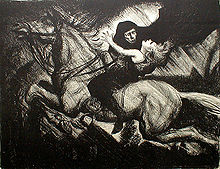
The poem by Johann Wolfgang von Goethe depicts the dying moments of a child assailed by a supernatural being, the Erlking or “Erlkönig”, while being carried home by his father on horseback through an alder forest.

Cf: http://en.wikipedia.org/wiki/Der_Erlk%C3%B6nig

http://www.lilibernard.com/Pages/DerErlkonig.html

Vocalists:

Marian Anderson (Contralto) – http://www.youtube.com/watch?v=D3K1rwihWLg

Friedrich Fischer-Dieskau (baritone) – http://www.youtube.com/watch?v=5XP5RP6OEJI&feature=related

Alexander Kipnis (bass) – http://www.youtube.com/watch?v=0u__MAvYrfg&feature=related

Elizabeth Schwarzkopf (Soprano) – http://www.youtube.com/watch?v=anud0zuGRj8

You should be able to tell the 4 voices in the song: the narrator, the father, the son, and the Erl King.

Original German Literal Translation Adaptation
Wer reitet so spät durch Nacht und Wind?
Es ist der Vater mit seinem Kind;
Er hat den Knaben wohl in dem Arm,
Er faßt ihn sicher, er hält ihn warm.

“Mein Sohn, was birgst du so bang dein Gesicht?” —
“Siehst, Vater, du den Erlkönig nicht?
Den Erlenkönig mit Kron und Schweif?” —
“Mein Sohn, es ist ein Nebelstreif.”

“Du liebes Kind, komm, geh mit mir!
Gar schöne Spiele spiel’ ich mit dir;
Manch’ bunte Blumen sind an dem Strand,
Meine Mutter hat manch gülden Gewand.” —

“Mein Vater, mein Vater, und hörest du nicht,
Was Erlenkönig mir leise verspricht?” —
“Sei ruhig, bleibe ruhig, mein Kind;
In dürren Blättern säuselt der Wind.” —

“Willst, feiner Knabe, du mit mir gehen?
Meine Töchter sollen dich warten schön;
Meine Töchter führen den nächtlichen Reihn,
Und wiegen und tanzen und singen dich ein.” —

“Mein Vater, mein Vater, und siehst du nicht dort
Erlkönigs Töchter am düstern Ort?” —
“Mein Sohn, mein Sohn, ich seh es genau:
Es scheinen die alten Weiden so grau. —”

“Ich liebe dich, mich reizt deine schöne Gestalt;
Und bist du nicht willig, so brauch ich Gewalt.” —
“Mein Vater, mein Vater, jetzt faßt er mich an!
Erlkönig hat mir ein Leids getan!” —

Dem Vater grauset’s, er reitet geschwind,
Er hält in Armen das ächzende Kind,
Erreicht den Hof mit Müh’ und Not;
In seinen Armen das Kind war tot.

Who rides, so late, through night and wind?
It is the father with his child.
He has the boy well in his arm
He holds him safely, he keeps him warm.

“My son, why do you hide your face so anxiously?”
“Father, do you not see the Erl king?
The Erl king with crown and tail?”
“My son, it’s a wisp of fog.”

“You lovely child, come, go with me!
Many a beautiful game I’ll play with you;
Many colourful flowers are on the shore,
My mother has many golden robes.”

“My father, my father, and don’t you hear
What Erl king is quietly promising me?”
“Be calm, stay calm, my child;
The wind is rustling through withered leaves.”

“Do you want to come with me, dear boy?
My daughters shall wait on you fine;
My daughters will lead the nightly dance,
And rock and dance and sing you to sleep.”

“My father, my father, and don’t you see there
Erl king’s daughters in the gloomy place?”
“My son, my son, I see it clearly:
The old willows they shimmer so grey.”

“I love you, your beautiful form entices me;
And if you’re not willing, I shall use force.”
“My father, my father, he’s grabbing me now!
Erl king has done me some harm!”

The father shudders; he swiftly rides on,
He holds the moaning child in his arms,
is hardly able to reach his farm;
In his arms, the child was dead.

Who rides there so late through the night dark and drear?
The father it is, with his infant so dear;
He holdeth the boy tightly clasp’d in his arm,
He holdeth him safely, he keepeth him warm.

“My son, wherefore seek’st thou thy face thus to hide?”
“Look, father, the Erl King is close by our side!
Dost see not the Erl King, with crown and with train?”
“My son, ’tis the mist rising over the plain.”

“Oh, come, thou dear infant! oh come thou with me!
For many a game I will play there with thee;
On my beach, lovely flowers their blossoms unfold,
My mother shall grace thee with garments of gold.”

“My father, my father, and dost thou not hear
The words that the Erl King now breathes in mine ear?”
“Be calm, dearest child, thy fancy deceives;
the wind is sighing through withering leaves.”

“Wilt go, then, dear infant, wilt go with me there?
My daughters shall tend thee with sisterly care
My daughters by night on the dance floor you lead,
They’ll cradle and rock thee, and sing thee to sleep.”

“My father, my father, and dost thou not see,
How the Erl King is showing his daughters to me?”
“My darling, my darling, I see it alright,
‘Tis the aged grey willows deceiving thy sight.”

“I love thee, I’m charm’d by thy beauty, dear boy!
And if thou aren’t willing, then force I’ll employ.”
“My father, my father, he seizes me fast,
For sorely the Erl King has hurt me at last.”

The father now gallops, with terror half wild,
He holds in his arms the shuddering child;
He reaches his farmstead with toil and dread,—
The child in his arms lies motionless, dead.

Der Nussbaum (The Nut Tree實果樹) Julius Mosen (1803-1867)

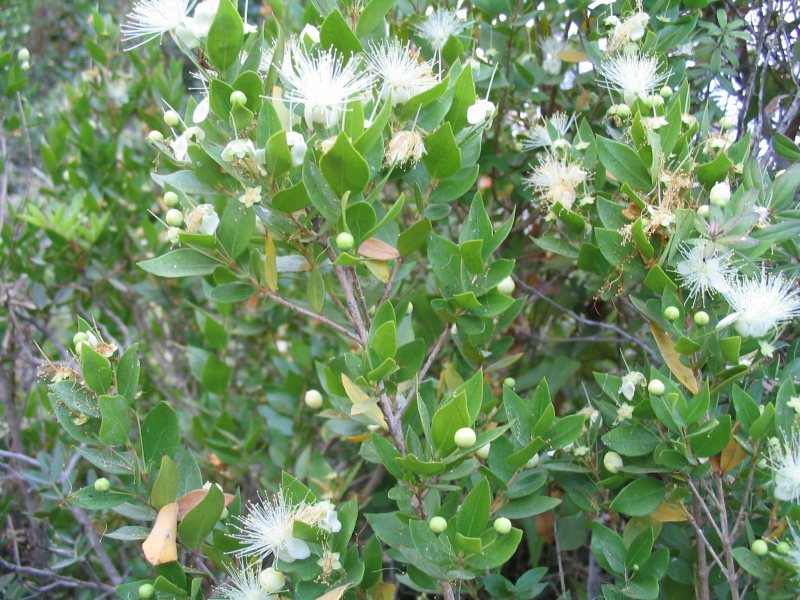
Robert Schumann’s Der Nussbaum comes from the song cycle (Myrthen) for voice & piano, Op. 25/3, he gave to his bride (Clara) on their wedding day.  It was named after the traditional bridal finery, Myrthens (Myrtles; Myrtus spp. 香桃木).

Nussbaum

The poem and lyrics by Julius Mosen tell of the whispers and caresses shared by two nut tree blossoms, revealing a certain maiden’s dreams of a bridegroom; nearby a girl listens, drifting gently into reverie.

[http://www.answers.com/topic/der-nussbaum-es-gr-net-ein-nussbaum-vor-dem-haus-song-for-voice-piano-myrthen-op-25-3]

Song videos:

Barbara Bonney (soprano) – http://www.youtube.com/watch?v=0p6v1mhSjYY

Marie-Nicole Lemieux (contralto) –  As the second lied starting at 3:18 —http://www.youtube.com/watch?v=bGvLPP_hyQg&feature=fvsr

Richard Tauber (tenor) – http://www.youtube.com/watch?v=40uPuWUvmrs&NR=1

Es grünet ein Nußbaum vor dem Haus,
Duftig, luftig breitet er blättrig die Blätter aus
Viel liebliche Blüten stehen dran
Linde Winde kommen, sie herzlich zu umfahn
Es flüstern je zwei zu zwei gepaart
Neigend, beugend zierlich zum Kusse die Häuptchen zart
Die flüstern von einem Mägdlein,
Das dächte die Nächte und Tage lang,
Wußte, ach! selber nicht was
Die flüstern – wer mag verstehn so gar leise Weis?
Flüstern von Bräut’gam und nächstem Jahr
Das Mägdlein horchet, es rauscht im Baum
Sehnend, wähnend sinkt es lächelnd in Schlaf und Traum.

Myrtus_communis

Tr. Sara Smith, Apr 22 2007, 09:33 PM

The nut-tree is turning green in front of the house,
Scented and airy it spreads its leaves
There are many sweet blossoms on it
Gentle winds come and blow tenderly round them
They whisper to each other in pairs
Nodding, bowing their sweet heads gently
They whisper of a young girl,
Who ponders night and day,
But still doesn’t know
They whisper – who could understand such soft wisdom?
They whisper about a groom and next year
The girl listens, it’s rustling in the tree
Longing and imagining she sinks smiling into sleep and dreams.

An die Musik (To Music 致音乐) Franz Adolf Friedrich von Schober (1796-1882)

A lied set to this poem of Franz von Schober by Franz Peter Schubert (1797-1828) , “An die Musik“, op. 88

no. 4, D. 547 (1817), published 1827.

As a hymn to the art of music, it is one of the best-known songs by Schubert. Its greatness and popularity are generally attributed to its harmonic simplicity, sweeping melody, and a strong bass line that effectively underpins the vocal line.

Ref. – http://en.wikipedia.org/wiki/An_die_Musik

The original score

Elisabeth Schwarzkopf (soprano): http://www.youtube.com/watch?v=Bm_AKMV0ME0

Fritz Wunderlich (tenor): http://www.youtube.com/watch?v=70_2p4OIZ7E

Kathleen Ferrier (contralto): http://www.youtube.com/watch?v=58VEGr2bwmg

Dietrich Fischer-Dieskau (baritone): http://www.youtube.com/watch?v=9TP9xXomDfk&feature=related

Erich Kunz (base-baritone): http://www.youtube.com/watch?v=JiqzDyUScL8

Franz Schubert

Du holde Kunst, in wieviel grauen Stunden,

Wo mich des Lebens wilder Kreis umstrickt,

Hast du mein Herz zu warmer Lieb entzunden,

Hast mich in eine beßre Welt entrückt!

Oft hat ein Seufzer, deiner Harf’ entflossen,

Ein süßer, heiliger Akkord von dir

Den Himmel beßrer Zeiten mir erschlossen,

Du holde Kunst, ich danke dir dafür!


Tr. Walter Meyer

Oh sacred art, how oft in hours blighted,

While into life’s untamed cycle hurled,

Hast thou my heart to warm love reignited

To transport me into a better world!

So often has a sigh from thy harp drifted,

A chord from thee, holy and full of bliss,

A glimpse of better times from heaven lifted.

Thou sacred art, my thanks to thee for this.

An die Freude (Ode To Joy)-Johann Christoph Friedrich von Schiller

歡樂颂

(德) 約翰.克里斯朵夫.費列迪克.逢.席勒 (1759 –1805)

–My New Year wish to all as we enter the second decade of the 21st century YK, Ottawa

Ode To Joy” is an ode written in 1785 by the German poet, playwright and historian Friedrich Schiller, celebrating the ideal of unity and brotherhood of all mankind. It is best known for its musical setting by Ludwig van Beethoven in the final movement of his Ninth Symphony (completed in 1824), a choral symphony for orchestra, four solo voices and choir.1

The Beethoven setting became the official anthem of the European Union in 1972; the former anthem of Rhodesia used its tune. It has been used in a number of other contexts; possibly the most famous use of it in American popular culture is within the Die Hard franchise. It was also used as a plot point in Stanley Kubrick’s 1971 movie A Clockwork Orange.

[From: http://en.wikipedia.org/wiki/Ode_to_Joy]

1 Video clips

Words written by Beethoven (not Schiller) are shown in italics. (http://raptusassociation.org/ode1785.html.)

German original English translation
O Freunde, nicht diese Töne!Sondern laßt uns angenehmere anstimmen,und freudenvollere.Freude! (men’s chorus: Freude! )

Freude! (chorus again: Freude! )

Oh friends, not these tones!Rather, let us raise our voices in more pleasingAnd more joyful sounds!Joy! (Joy!)

Joy! (Joy!)

Freude, schöner Götterfunken*Tochter aus Elysium,Wir betreten feuertrunken,Himmlische, dein Heiligtum!

Deine Zauber binden wieder

Was die Mode streng geteilt;

Alle Menschen werden Brüder,

Wo dein sanfter Flügel weilt.

Joy, beautiful spark of divinity*Daughter of Elysium,We enter, drunk with fire,Into your sanctuary, heavenly (daughter)!

Your magic reunites

What custom strictly divided.

All men become brothers,

Where your gentle wing rests.

Wem der große Wurf gelungen,Eines Freundes Freund zu sein;Wer ein holdes Weib errungen,Mische seinen Jubel ein!

Ja, wer auch nur eine Seele

Sein nennt auf dem Erdenrund!

Und wer’s nie gekonnt, der stehle

Weinend sich aus diesem Bund!

Whoever has had the great fortuneTo be a friend’s friend,Whoever has won a devoted wife,Join in our jubilation!

Indeed, whoever can call even one soul,

His own on this earth!

And whoever was never able to, must creep

Tearfully away from this band!

Freude trinken alle WesenAn den Brüsten der Natur;Alle Guten, alle BösenFolgen ihrer Rosenspur.

Küße gab sie uns und Reben,

Einen Freund, geprüft im Tod;

Wollust ward dem Wurm gegeben,

Und der Cherub steht vor Gott.

Vor Gott!

Joy all creatures drinkAt the breasts of nature;All good, all badFollow her trail of roses.

Kisses she gave us, and wine,

A friend, proved in death;

Pleasure was given to the worm,

And the cherub stands before God.

Before God!

Froh, wie seine Sonnen fliegenDurch des Himmels prächt’gen Plan,Laufet, Brüder, eure Bahn,Freudig, wie ein Held zum Siegen. Glad, as His suns flyThrough the Heaven’s glorious design,Run, brothers, your path,Joyful, as a hero to victory.
Seid umschlungen, Millionen!Diesen Kuß der ganzen Welt!Brüder, über’m SternenzeltMuss ein lieber Vater wohnen.

Ihr stürzt nieder, Millionen?

Ahnest du den Schöpfer, Welt?

Such’ ihn über’m Sternenzelt!

Über Sternen muss er wohnen.

Be embraced, millions!This kiss for the whole world!Brothers, above the starry canopyMust a loving Father dwell.

Do you bow down, millions?

Do you sense the Creator, world?

Seek Him beyond the starry canopy!

Beyond the stars must He dwell.

Finale repeats the words:Seid umschlungen, Millionen!Diesen Kuß der ganzen Welt!Brüder, über’m Sternenzelt

Muss ein lieber Vater wohnen.

Seid umschlungen,

Diesen Kuß der ganzen Welt!

Freude, schöner Götterfunken

Tochter aus Elysium,

Freude, schöner Götterfunken

Götterfunken!

Finale repeats the words:Be embraced, you millions!This kiss for the whole world!Brothers, beyond the star-canopy

Must a loving Father dwell.

Be embraced,

This kiss for the whole world!

Joy, beautiful spark of divinity,

Daughter of Elysium,

Joy, beautiful spark of divinity

Divinity!

* The vocal part of Beethoven’s 9th Symphony thus ends with the final word”Götterfunken” (literally, “Godly-spark”).