
The blog software has been upgraded to v3.0.4. Please click here to report any problem.
The blog software has been upgraded to v3.0.4. Please click here to report any problem.
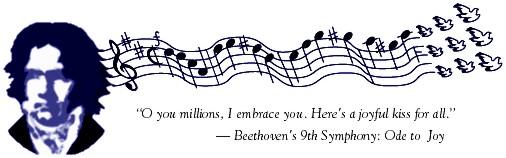

歡樂颂
(德) 約翰.克里斯朵夫.費列迪克.逢.席勒 (1759 –1805)
–My New Year wish to all as we enter the second decade of the 21st century YK, Ottawa
“Ode To Joy” is an ode written in 1785 by the German poet, playwright and historian Friedrich Schiller, celebrating the ideal of unity and brotherhood of all mankind. It is best known for its musical setting by Ludwig van Beethoven in the final movement of his Ninth Symphony (completed in 1824), a choral symphony for orchestra, four solo voices and choir.1
The Beethoven setting became the official anthem of the European Union in 1972; the former anthem of Rhodesia used its tune. It has been used in a number of other contexts; possibly the most famous use of it in American popular culture is within the Die Hard franchise. It was also used as a plot point in Stanley Kubrick’s 1971 movie A Clockwork Orange.
[From: http://en.wikipedia.org/wiki/Ode_to_Joy]
1 Video clips
Words written by Beethoven (not Schiller) are shown in italics. (http://raptusassociation.org/ode1785.html.)
| German original | English translation |
| O Freunde, nicht diese Töne!Sondern laßt uns angenehmere anstimmen,und freudenvollere.Freude! (men’s chorus: Freude! )
Freude! (chorus again: Freude! ) |
Oh friends, not these tones!Rather, let us raise our voices in more pleasingAnd more joyful sounds!Joy! (Joy!)
Joy! (Joy!) |
| Freude, schöner Götterfunken*Tochter aus Elysium,Wir betreten feuertrunken,Himmlische, dein Heiligtum!
Deine Zauber binden wieder Was die Mode streng geteilt; Alle Menschen werden Brüder, Wo dein sanfter Flügel weilt. |
Joy, beautiful spark of divinity*Daughter of Elysium,We enter, drunk with fire,Into your sanctuary, heavenly (daughter)!
Your magic reunites What custom strictly divided. All men become brothers, Where your gentle wing rests. |
| Wem der große Wurf gelungen,Eines Freundes Freund zu sein;Wer ein holdes Weib errungen,Mische seinen Jubel ein!
Ja, wer auch nur eine Seele Sein nennt auf dem Erdenrund! Und wer’s nie gekonnt, der stehle Weinend sich aus diesem Bund! |
Whoever has had the great fortuneTo be a friend’s friend,Whoever has won a devoted wife,Join in our jubilation!
Indeed, whoever can call even one soul, His own on this earth! And whoever was never able to, must creep Tearfully away from this band! |
| Freude trinken alle WesenAn den Brüsten der Natur;Alle Guten, alle BösenFolgen ihrer Rosenspur.
Küße gab sie uns und Reben, Einen Freund, geprüft im Tod; Wollust ward dem Wurm gegeben, Und der Cherub steht vor Gott. Vor Gott! |
Joy all creatures drinkAt the breasts of nature;All good, all badFollow her trail of roses.
Kisses she gave us, and wine, A friend, proved in death; Pleasure was given to the worm, And the cherub stands before God. Before God! |
| Froh, wie seine Sonnen fliegenDurch des Himmels prächt’gen Plan,Laufet, Brüder, eure Bahn,Freudig, wie ein Held zum Siegen. | Glad, as His suns flyThrough the Heaven’s glorious design,Run, brothers, your path,Joyful, as a hero to victory. |
| Seid umschlungen, Millionen!Diesen Kuß der ganzen Welt!Brüder, über’m SternenzeltMuss ein lieber Vater wohnen.
Ihr stürzt nieder, Millionen? Ahnest du den Schöpfer, Welt? Such’ ihn über’m Sternenzelt! Über Sternen muss er wohnen. |
Be embraced, millions!This kiss for the whole world!Brothers, above the starry canopyMust a loving Father dwell.
Do you bow down, millions? Do you sense the Creator, world? Seek Him beyond the starry canopy! Beyond the stars must He dwell. |
| Finale repeats the words:Seid umschlungen, Millionen!Diesen Kuß der ganzen Welt!Brüder, über’m Sternenzelt
Muss ein lieber Vater wohnen. Seid umschlungen, Diesen Kuß der ganzen Welt! Freude, schöner Götterfunken Tochter aus Elysium, Freude, schöner Götterfunken Götterfunken! |
Finale repeats the words:Be embraced, you millions!This kiss for the whole world!Brothers, beyond the star-canopy
Must a loving Father dwell. Be embraced, This kiss for the whole world! Joy, beautiful spark of divinity, Daughter of Elysium, Joy, beautiful spark of divinity Divinity! |
* The vocal part of Beethoven’s 9th Symphony thus ends with the final word”Götterfunken” (literally, “Godly-spark”).
(Through Rose-Coloured Glasses)
Wishing you all a happy and prosperous new year.
广州话趣
You can add more to this. Enjoy.
For introduction, see “La Primavera” Antonio Vivaldi (1678-1741)


Itzhak Perlman (violin) performing Vivaldi’s Four Seasons: Winter
I. http://www.youtube.com/watch?v=rBq4ov5Y_84&feature=related
II. http://www.youtube.com/watch?v=dggfA9Vo64U&feature=related
Tr. YK Chan 陈耀国譯
| L’inverno (Winter) – Concerto in f-minor
Allegro non molto Largo Allegro |
冬 – F 小调协奏曲
不太快的快板 在刺骨的冷风中结了冰; 来去走动地大踏步, 慢板 在炉灶旁安乐地休息, 在外面的却被大雨淋透. 在冰地上慢慢小心地走, 然后,爬起来,急跑过冰地不让它裂开. 虽然门户都已杣锁好… |

The blog software has been upgraded to v3.0.3. Please click here to report any problem.
Der Lindenbaum is the 5th of the Winterreise (Winter Journey 冬之旅) cycle of 24 poems by Wilhelm Müller, best known as the song cycle set for voice and piano by Franz Schubert (D. 911, published as Op. 89 in 1827). It is the second of Schubert’s two great song cycles on Müller’s poems. It was originally written for tenor voice but also transcribed for other voice ranges.

Poem/lyric synopsis: “The wanderer comes to the linden tree, with its pale flowers and heart-shaped leaves that stands at the gate. In the shade of this tree he has dreamt many beautiful dreams, and in the bark he has carved words of love. It was his favourite place. Now he passes it with his eyes shut, even though it is deepest night, but the branches rustle to him, ‘Come to me weary traveler, You’ll find your peace with me’. A gust of wind blows his hat off, and many hours afterwards he remembers the tree, and it seems to say ‘You’ll find your peace with me.’ It is a tacit invitation to suicide.”
[Cf. http://en.wikipedia.org/wiki/Winterreise; http://www.gopera.com/winterreise/articles/rp_lied05.mv]
Sung by:
Dietrich Fischer-Dieskau (baritone) – http://www.youtube.com/watch?v=jyxMMg6bxrg&feature=related
Alexander Kipnis (bass) – http://www.youtube.com/watch?v=AdLVzVkvRcg&feature=related


|
Am Brunnen vor dem Tore
Da steht ein Lindenbaum Ich träumt in seinem Schatten So manchen süßen Traum Ich schnitt in seine Rinde so manches liebes Wort Es zog in Freud und Leide Zu ihm mich immer fort Die kalten Winde bliesen
Mir grad ins Angesicht Der Hut flog mir vom Kopfe Ich wendete mich nicht Nun bin ich manche Stunde Entfernt von diesem Ort Und immer hör ich’s rauschen: “Du fändest Ruhe dort Ich mußt auch heute wandern
Vorbei in tiefer Nacht Da hab ich noch im Dunkel Die Augen zugemacht Und seine Zweige rauschten Als riefen sie mir zu: “Komm her zu mir, Geselle Hier findst du deine Ruh |
[Tr. Frank, 2001]
Outside the gate’s a fountain Today I still must wander The frigid winds were blowing |

(Through Rose-Coloured Glasses)
If I Had a hammer
(Words and music by L. Hays and P. Seeger)
If I had a hammer
I’d hammer in the morning
I’d hammer in the evening … all over this land,
I’d hammer out danger
I’d hammer out a warning
I’d hammer out love between all of my brothers and my sisters
All over this land.
If I had a bell
I’d ring it in the morning
I’d ring it in the evening … all over this land,
I’d ring out danger
I’d ring out a warning
I’d ring out love between all of my brothers and my sisters
All over this land.
If I had a song
I’d sing it in the morning
I’d sing it in the evening … all over this world,
I’d sing out danger
I’d sing out a warning
I’d sing out love between all of my brothers and my sisters
All over this land.
If I’ve got a hammer
And I’ve got a bell
And I’ve got a song to sing … all over this land,
It’s a hammer of justice
It’s a bell of freedom
It’s a song about love between all of my brothers and my sisters
All over this land.

Light One Candle (by Peter Yarrow)

It is better to light one candle than to curse the darkness. – Chinese proverb
Light one candle for the terrible sacrifice
Justice and freedom demand
But light one candle for the wisdom to know
When the peacemaker’s time is at hand
Don’t let the light go out
It’s lasted for so many years
Don’t let the light go out
Let it shine through our love and our tears
Light one candle for the strength that we need
To never become our own foe
And light one candle for those who are suffering
Pain we learned so long ago
Light one candle for all we believe in
That anger not tear us apart
And light one candle to find us together
With peace as the song in our hearts
Don’t let the light go out
It’s lasted for so many years
Don’t let the light go out
Let it shine through our love and our tears
Don’t let the light go out
It’s lasted for so many years
Don’t let the light go out
Let it shine through our love and our tears
What is the memory that’s valued so highly
That we keep it alive in that flame?
What’s the commitment to those who died
That we cry out they’ve not died in vain?
We have come this far always believing
That justice would somehow prevail
This is the burden, this is the promise
This is why we will not fail
Don’t let the light go out
It’s lasted for so many years
Don’t let the light go out
Let it shine through our love and our tears
Don’t let the light go out
It’s lasted for so many years
Don’t let the light go out
Let it shine through our love and our tears
Don’t let the light go out
Don’t let the light go out
Don’t let the light go out
http://www.youtube.com/watch?v=3yZ1zxtbOJE
A German poem based on a text in English by William Shakespeare (1564-1616) , from Two Gentlemen of Verona (http://en.wikipedia.org/wiki/Two_Gentlemen_of_Verona), Act IV, Scene 2.



It’s also a lied set to this text by Franz Peter Schubert (1797-1828) , “An Silvia“, op. 106 no. 4, D. 891 (1826). Sung by:
Fritz Wunderlich (tenor) – http://www.youtube.com/watch?v=14AT7-79oJk&feature=related
Lucia Popp (soprano) – http://www.youtube.com/watch?v=gX8BuKKpVeY&feature=fvw
Janet Baker (mezzo-soprano) – In English http://www.youtube.com/watch?v=o8vHk038_VY&feature=related
| Was ist Silvia, saget an, Daß sie die weite Flur preist? Schön und zart seh ich sie nahn, Auf Himmelsgunst und Spur weist, Daß ihr alles untertan. |
| Ist sie schön und gut dazu? Reiz labt wie milde Kindheit; Ihrem Aug’ eilt Amor zu, Dort heilt er seine Blindheit Und verweilt in süßer Ruh. |
| Darum Silvia, tön, o Sang, Der holden Silvia Ehren; Jeden Reiz besiegt sie lang, Den Erde kann gewähren: Kränze ihr und Saitenklang! |
| Original English text:Who is Silvia? What is she, That all our swains commend her? Holy, fair, and wise is she; The heaven such grace did lend her, That she might admirèd be. |
| Is she kind as she is fair? For beauty lives with kindness. Love doth to her eyes repair, To help him of his blindness, And, being help’d, inhabits there. |
| Then to Silvia let us sing, That Silvia is excelling; She excels each mortal thing Upon the dull earth dwelling: To her let us garlands bring. |