An die Musik (To Music 致音乐) Franz Adolf Friedrich von Schober (1796-1882)

A lied set to this poem of Franz von Schober by Franz Peter Schubert (1797-1828) , “An die Musik“, op. 88

no. 4, D. 547 (1817), published 1827.

As a hymn to the art of music, it is one of the best-known songs by Schubert. Its greatness and popularity are generally attributed to its harmonic simplicity, sweeping melody, and a strong bass line that effectively underpins the vocal line.

Ref. – http://en.wikipedia.org/wiki/An_die_Musik

The original score

Elisabeth Schwarzkopf (soprano): http://www.youtube.com/watch?v=Bm_AKMV0ME0

Fritz Wunderlich (tenor): http://www.youtube.com/watch?v=70_2p4OIZ7E

Kathleen Ferrier (contralto): http://www.youtube.com/watch?v=58VEGr2bwmg

Dietrich Fischer-Dieskau (baritone): http://www.youtube.com/watch?v=9TP9xXomDfk&feature=related

Erich Kunz (base-baritone): http://www.youtube.com/watch?v=JiqzDyUScL8

Franz Schubert

Du holde Kunst, in wieviel grauen Stunden,

Wo mich des Lebens wilder Kreis umstrickt,

Hast du mein Herz zu warmer Lieb entzunden,

Hast mich in eine beßre Welt entrückt!

Oft hat ein Seufzer, deiner Harf’ entflossen,

Ein süßer, heiliger Akkord von dir

Den Himmel beßrer Zeiten mir erschlossen,

Du holde Kunst, ich danke dir dafür!


Tr. Walter Meyer

Oh sacred art, how oft in hours blighted,

While into life’s untamed cycle hurled,

Hast thou my heart to warm love reignited

To transport me into a better world!

So often has a sigh from thy harp drifted,

A chord from thee, holy and full of bliss,

A glimpse of better times from heaven lifted.

Thou sacred art, my thanks to thee for this.

An die Freude (Ode To Joy)-Johann Christoph Friedrich von Schiller

歡樂颂

(德) 約翰.克里斯朵夫.費列迪克.逢.席勒 (1759 –1805)

–My New Year wish to all as we enter the second decade of the 21st century YK, Ottawa

“Ode To Joy” is an ode written in 1785 by the German poet, playwright and historian Friedrich Schiller, celebrating the ideal of unity and brotherhood of all mankind. It is best known for its musical setting by Ludwig van Beethoven in the final movement of his Ninth Symphony (completed in 1824), a choral symphony for orchestra, four solo voices and choir.1

The Beethoven setting became the official anthem of the European Union in 1972; the former anthem of Rhodesia used its tune. It has been used in a number of other contexts; possibly the most famous use of it in American popular culture is within the Die Hard franchise. It was also used as a plot point in Stanley Kubrick’s 1971 movie A Clockwork Orange.

[From: http://en.wikipedia.org/wiki/Ode_to_Joy]

1 Video clips

Words written by Beethoven (not Schiller) are shown in italics. (http://raptusassociation.org/ode1785.html.)

German original English translation
O Freunde, nicht diese Töne!Sondern laßt uns angenehmere anstimmen,und freudenvollere.Freude! (men’s chorus: Freude! )

Freude! (chorus again: Freude! )

Oh friends, not these tones!Rather, let us raise our voices in more pleasingAnd more joyful sounds!Joy! (Joy!)

Joy! (Joy!)

Freude, schöner Götterfunken*Tochter aus Elysium,Wir betreten feuertrunken,Himmlische, dein Heiligtum!

Deine Zauber binden wieder

Was die Mode streng geteilt;

Alle Menschen werden Brüder,

Wo dein sanfter Flügel weilt.

Joy, beautiful spark of divinity*Daughter of Elysium,We enter, drunk with fire,Into your sanctuary, heavenly (daughter)!

Your magic reunites

What custom strictly divided.

All men become brothers,

Where your gentle wing rests.

Wem der große Wurf gelungen,Eines Freundes Freund zu sein;Wer ein holdes Weib errungen,Mische seinen Jubel ein!

Ja, wer auch nur eine Seele

Sein nennt auf dem Erdenrund!

Und wer’s nie gekonnt, der stehle

Weinend sich aus diesem Bund!

Whoever has had the great fortuneTo be a friend’s friend,Whoever has won a devoted wife,Join in our jubilation!

Indeed, whoever can call even one soul,

His own on this earth!

And whoever was never able to, must creep

Tearfully away from this band!

Freude trinken alle WesenAn den Brüsten der Natur;Alle Guten, alle BösenFolgen ihrer Rosenspur.

Küße gab sie uns und Reben,

Einen Freund, geprüft im Tod;

Wollust ward dem Wurm gegeben,

Und der Cherub steht vor Gott.

Vor Gott!

Joy all creatures drinkAt the breasts of nature;All good, all badFollow her trail of roses.

Kisses she gave us, and wine,

A friend, proved in death;

Pleasure was given to the worm,

And the cherub stands before God.

Before God!

Froh, wie seine Sonnen fliegenDurch des Himmels prächt’gen Plan,Laufet, Brüder, eure Bahn,Freudig, wie ein Held zum Siegen. Glad, as His suns flyThrough the Heaven’s glorious design,Run, brothers, your path,Joyful, as a hero to victory.
Seid umschlungen, Millionen!Diesen Kuß der ganzen Welt!Brüder, über’m SternenzeltMuss ein lieber Vater wohnen.

Ihr stürzt nieder, Millionen?

Ahnest du den Schöpfer, Welt?

Such’ ihn über’m Sternenzelt!

Über Sternen muss er wohnen.

Be embraced, millions!This kiss for the whole world!Brothers, above the starry canopyMust a loving Father dwell.

Do you bow down, millions?

Do you sense the Creator, world?

Seek Him beyond the starry canopy!

Beyond the stars must He dwell.

Finale repeats the words:Seid umschlungen, Millionen!Diesen Kuß der ganzen Welt!Brüder, über’m Sternenzelt

Muss ein lieber Vater wohnen.

Seid umschlungen,

Diesen Kuß der ganzen Welt!

Freude, schöner Götterfunken

Tochter aus Elysium,

Freude, schöner Götterfunken

Götterfunken!

Finale repeats the words:Be embraced, you millions!This kiss for the whole world!Brothers, beyond the star-canopy

Must a loving Father dwell.

Be embraced,

This kiss for the whole world!

Joy, beautiful spark of divinity,

Daughter of Elysium,

Joy, beautiful spark of divinity

Divinity!

* The vocal part of Beethoven’s 9th Symphony thus ends with the final word”Götterfunken” (literally, “Godly-spark”).

冬L’inverno (Winter) Antonio Vivaldi (1678 – 1741)(意) 安东尼奥. 菲凡尔迪

For introduction, see “La Primavera” Antonio Vivaldi (1678-1741)

Itzhak Perlman (violin) performing Vivaldi’s Four Seasons: Winter

I.  http://www.youtube.com/watch?v=rBq4ov5Y_84&feature=related

II.  http://www.youtube.com/watch?v=dggfA9Vo64U&feature=related

  1. http://www.youtube.com/watch?v=x8DzsScxhBE&feature=related

Tr. YK Chan 陈耀国譯

L’inverno (Winter) – Concerto in f-minor

Allegro non molto
“Aggiacciato tremar trà neri algenti
Al Severo Spirar d’ orrido Vento,
Correr battendo i piedi ogni momento;
E pel Soverchio gel batter i denti;”

Largo
“Passar al foco i di quieti e contenti
Mentre la pioggia fuor bagna ben cento”

Allegro
“Caminar Sopra ‘l giaccio, e à passo lento
Per timor di cader gersene intenti;
Gir forte Sdruzziolar, cader à terra
Di nuove ir Sopra ‘l giaccio e correr forte
Sin ch’ il giaccio si rompe, e si disserra;
Sentir uscir dalle ferrate porte
Sirocco Borea, e tutti i Venti in guerra
Quest’ é ‘l verno, mà tal, che gioja apporte.”

冬 – F 小调协奏曲

不太快的快板
战栗着, 霜寒的雪

在刺骨的冷风中结了冰;

来去走动地大踏步,
也在寒气里齒震.

慢板

在炉灶旁安乐地休息,

在外面的却被大雨淋透.

快板

在冰地上慢慢小心地走,
因害怕跌交摔倒.
就突然拐个弯,滑了,跌在地上

然后,爬起来,急跑过冰地不让它裂开.
感觉到寒冷的北风直透家里

虽然门户都已杣锁好…
这是冬天,然而它带来它特有的欢乐.

Der Lindenbaum (The Linden Tree 椴树/菩提树) by Wilhelm Müller

Der Lindenbaum is the 5th of the Winterreise (Winter Journey 冬之旅) cycle of 24 poems by Wilhelm Müller, best known as the song cycle set for voice and piano by Franz Schubert (D. 911, published as Op. 89 in 1827). It is the second of Schubert’s two great song cycles on Müller’s poems. It was originally written for tenor voice but also transcribed for other voice ranges.

Poem/lyric synopsis:  “The wanderer comes to the linden tree, with its pale flowers and heart-shaped leaves that stands at the gate. In the shade of this tree he has dreamt many beautiful dreams, and in the bark he has carved words of love. It was his favourite place. Now he passes it with his eyes shut, even though it is deepest night, but the branches rustle to him, ‘Come to me weary traveler, You’ll find your peace with me’. A gust of wind blows his hat off, and many hours afterwards he remembers the tree, and it seems to say ‘You’ll find your peace with me.’ It is a tacit invitation to suicide.”

[Cf. http://en.wikipedia.org/wiki/Winterreise; http://www.gopera.com/winterreise/articles/rp_lied05.mv] 

Sung by:

Dietrich Fischer-Dieskau (baritone) – http://www.youtube.com/watch?v=jyxMMg6bxrg&feature=related

Alexander Kipnis (bass) – http://www.youtube.com/watch?v=AdLVzVkvRcg&feature=related

Am Brunnen vor dem Tore
Da steht ein Lindenbaum
Ich träumt in seinem Schatten
So manchen süßen Traum
Ich schnitt in seine Rinde
so manches liebes Wort
Es zog in Freud und Leide
Zu ihm mich immer fort
 
Die kalten Winde bliesen
Mir grad ins Angesicht
Der Hut flog mir vom Kopfe
Ich wendete mich nicht
Nun bin ich manche Stunde
Entfernt von diesem Ort
Und immer hör ich’s rauschen:
“Du fändest Ruhe dort
 
 Ich mußt auch heute wandern
Vorbei in tiefer Nacht
Da hab ich noch im Dunkel
Die Augen zugemacht
Und seine Zweige rauschten
Als riefen sie mir zu:
“Komm her zu mir, Geselle
Hier findst du deine Ruh
  [Tr. Frank, 2001]

Outside the gate’s a fountain
And an old Linden tree,
Under its shady branches
My dreams were sweet and free.
I carved in its old bark,
So many phrases dear.
In times of joy and sadness
It always drew me near.

Today I still must wander
All through the gloomy night
’twas then that in the darkness
I closed my eyes so tight.
And I heard branches whisper
As if they called to me:
Come to me weary traveler,
You’ll find your peace with me.

The frigid winds were blowing
Against my face and me.
My hat flew into darkness,
I did not turn to see.
Now I am many hours
Away from this old tree
And still I hear it whispering
You’d find your peace with me.

An Silvia (To Silvia/Who is Silvia? 谁是西尔维亚?) Eduard von Bauernfeld (1802-1890)

A German poem based on a text in English by William Shakespeare (1564-1616) , from Two Gentlemen of Verona (http://en.wikipedia.org/wiki/Two_Gentlemen_of_Verona), Act IV, Scene 2.


It’s also a lied set to this text by Franz Peter Schubert (1797-1828) , “An Silvia“, op. 106 no. 4, D. 891 (1826).  Sung by:

Fritz Wunderlich (tenor) – http://www.youtube.com/watch?v=14AT7-79oJk&feature=related

Lucia Popp (soprano) – http://www.youtube.com/watch?v=gX8BuKKpVeY&feature=fvw

Janet Baker (mezzo-soprano) – In English http://www.youtube.com/watch?v=o8vHk038_VY&feature=related

Was ist Silvia, saget an,
Daß sie die weite Flur preist?
Schön und zart seh ich sie nahn,
Auf Himmelsgunst und Spur weist,
Daß ihr alles untertan.
Ist sie schön und gut dazu?
Reiz labt wie milde Kindheit;
Ihrem Aug’ eilt Amor zu,
Dort heilt er seine Blindheit
Und verweilt in süßer Ruh.
Darum Silvia, tön, o Sang,
Der holden Silvia Ehren;
Jeden Reiz besiegt sie lang,
Den Erde kann gewähren:
Kränze ihr und Saitenklang!
 
Original English text:Who is Silvia? What is she,
That all our swains commend her?
Holy, fair, and wise is she;
The heaven such grace did lend her,
That she might admirèd be.
Is she kind as she is fair?
For beauty lives with kindness.
Love doth to her eyes repair,
To help him of his blindness,
And, being help’d, inhabits there.
Then to Silvia let us sing,
That Silvia is excelling;
She excels each mortal thing
Upon the dull earth dwelling:
To her let us garlands bring.

Three German cradle songs (Drei Wiegenlieder) 德文摇籃曲三首

 1.  Wiegenlied (Op. 49, No. 4)            Johannes Brahms (1833-1897)

Sung by:

Hermann Prey (baritone) –

 http://www.youtube.com/watch?v=-6VEkG09Qkc&feature=more_related

Anne Sofie von Otter (mezzo-soprano) – 

 http://www.youtube.com/watch?v=YphiCF3bxrE

Elisabeth Schumann (soprano)

 http://www.youtube.com/watch?v=-aeTY4fhxA4&feature=related

Carreras, Domingo, Pavarotti (tenors) – 

 http://www.youtube.com/watch?v=MHVaw4FYXCQ

Note: The first verse is taken from a collection of German folk poems called Des Knaben Wunderhorn.

Guten Abend, gut Nacht,

Mit Rosen bedacht,

Mit Näglein besteckt,

Schlupf unter die Deck’:

Morgen früh, wenn Gott will,

Wirst du wieder geweckt.


Guten Abend, gut Nacht,

Von Englein bewacht,

Die zeigen im Traum

Dir Christkindleins Baum:

Schlaf nun selig und süß,

Schau im Traum’s Paradies.

Tr. Emily Ezust

Good evening, good night,

Bedecked with roses,

Covered with carnations,

Slip under the blanket

Early tomorrow, God willing,

Will you be waken again.

Good evening, good night,

Guarded by angels,

Who indicate to you by dream

The tree of the Christ child:

Sleep now blissfully and sweetly,

Behold Paradise in your dreams.

 2.      For a long time this Wiegenlied was attributed to Mozart (K. 350 – 1780). However it is now believed to be by Bernhard Flies (~ 1770 – ?) from the theatre play “Esther” (Leipzig 1795) written by Friedrich Wilhelm Gotter (1746-1797).

Renditions by:

Karin Shifrin (mezzo-soprano) – http://www.youtube.com/watch?v=mA4IUgihLio

Esther Ofarim (soprano) – http://www.youtube.com/watch?v=_eKcfd0_CsU

Vienna Boys Choir – http://www.youtube.com/watch?v=CPOzkkHBAqo

Hayley Westenra (soprano) – http://www.youtube.com/watch?v=nUJN3KznBRE&feature=related

Schlafe, mein Prinzchen, schlaf ein,
es ruhn Schäfchen und Vögelein.
Gärten und Wiesen verstummt,
auch nicht ein Bienchen mehr summt.
Luna mit silbernem Schein
Gucket zum Fenster herein;
schlafe beim silbernen Schein!
Schlafe, mein Prinzchen, schlaf ein!
Schlaf ein, schlaf ein!

Alles im Schlosse schon liegt,

alles in Schlummer gewiegt,

reget kein Mäuschen sich mehr,

Keller und Küche sind leer,

nur in der Zofe Gemach

tönet ein schmachtendes Ach!

Was für ein Ach mag dies sein?

Schlafe, mein Prinzchen, schlaf ein.

Wer ist beglückter als Du?
Nichts als Vergnügen und Ruh
Spielwerk und Zucker vollauf
und noch Karossen im Lauf
Alles besorgt und bereit,
daß nur mein Prinzchen nicht schreit
Was wird das künftig noch sein?
Schlafe mein Prinzchen, schlaf ein.
Schlaf ein, schlaf ein.

Tr. Emily Ezust

Sleep, my little prince, fall asleep:

 the lambs and birdies are resting,

 the garden and meadow are silent,

 and even the little bee hums no more.

 Luna with a silver gleam

 is pouring her light into the window.

 Sleep by the silvery light,

 sleep, my little prince, fall asleep!

 Everyone in the castle is already lying down:

 everyone is cradled in slumber,

 and even the little mouse rustles no more.

 The cellar and kitchen are empty,

 only in the chambermaid’s quarters

 one can hear a languishing sigh!

 What kind of sigh might this be?

 Sleep, my little prince, fall asleep!

 Who is happier than you?

 Nothing but amusement and rest!

 Toys and sugar enough,

 and even a stately coach to convey you;

 everyone is careful and ready

 so that my little prince will not shriek.

 But what will the future bring?

 Sleep, my little prince, fall asleep.

3.  Wiegenlied (D. 498, op. 98 No. 2)              Franz Schubert (1797-1828)

Sung by:

Gundula Janowitz (soprano) – http://www.youtube.com/watch?v=QSII_tDIBa4&NR=1

Irmgard Seefried (soprano) – http://www.youtube.com/watch?v=S3r3FzAGqeE&feature=related

Janet Baker (mezzo-soprano) – http://www.youtube.com/watch?v=N2zXK-qyOXQ

Schlafe, schlafe, holder süßer Knabe,
Leise wiegt dich deiner Mutter Hand;
Sanfte Ruhe, milde Labe
Bringt dir schwebend dieses Wiegenband.

Schlafe, schlafe in dem süßen Grabe,
Noch beschützt dich deiner Mutter Arm,
Alle Wünsche, alle Habe
Faßt sie lieben, alle liebwarm.

Schlafe, schlafe in der Flaumen Schoße,
Noch umtönt dich lauter Liebeston,
Eine Lilie, eine Rose,
Nach dem Schlafe werd’ sie dir zum Lohn.

Tr. Linda Godry

Do sleep, do sleep, lovely, sweet boy,

To the gentle rocking of your mother’s hand;

Peaceful sleep, and recreation

Does come floating with each gentle pull.

Do sleep, do sleep in your sweet berth,

Still protected by your mother’s arm,

All her wishes, all your talents

Encompassing, in her steady love.

Do sleep, do sleep, in that downy embrace,

Still you only hear a gentle crooning,

Dewy flowers: lilies and roses,

After slumber they will be your prize.

《虞美人》 听雨 (南宋) 蒋捷

少年听雨歌楼上,红烛昏罗帐。壮年听雨客舟中,江阔云低,断雁叫西风。

而今听雨僧庐下,鬓已星星也。悲欢离合总无情,一任阶前,点滴到天明。


 Tune: Lady Yu the Beauty                  Jiang Jie (13th Century)

 Listening to the rain          

[Tr. YK Chan  陈耀国译] 

When young listening to the rain as songs were sung on the floor above,

From crimson candles smoke lingered onto the canopied bed of love.

When I travelled middle-aged, listening to the rain on a passenger boat,

Above a river wide clouds hung low,

A lost goose cried as the chilly west wind blowed.


Now listening to the rain at the monk’s lodge,

My hair has speckled and scattered without dodge,

Sadness and happiness, separation and reunion impassion me no more.

The rain pours on the terrace galore,

then drizzles until dawn.

————————-

Note:   Joseph Needham (1900-95), “The Man Who Loved China” (a biography by Simon Winchester http://www.youtube.com/watch?v=b1j2zs4Xwqk), translated this poem with the help of his friends thus:

As a young man, listening to the girls in a tower
   I heard the sound of the rain,
While the red candle burned dim in the damp air.
In middle age, travelling by boat on a river,
      I listened to the rain falling, falling;
   The river was wide and clouds drifted above;
I heard the solitary cry of a teal borne on the west wind.
    And now in a cloister cell I hear the rain again,
      My hair is grey and sparse;
Sadness and Happiness, separation and reunion, all seem one,
     They move me no more.
Let the rain drop all night on the deserted pavement
    Till the day dawns.

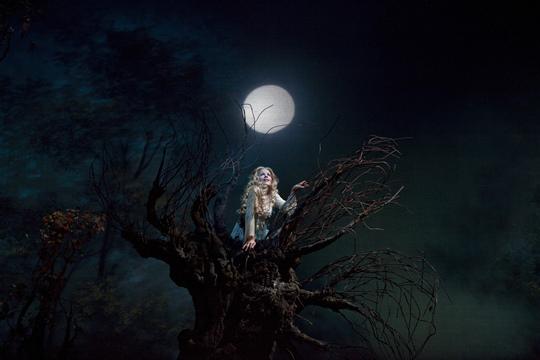
“Pisen Rusalky O Mesicku” (Song to the Moon) Jaroslav Kvapil (1868–1950)

Renée Fleming as Rusalka in NY Met production

捷克歌剧<露莎尓卡>之女高音咏叹調<唱给月亮>

Soprano aria from Rusalka, a Czech opera by Antonín Dvořák. The Czech libretto was written by
the poet Jaroslav Kvapil based on the fairy tales of Karel Jaromír Erben and Božena Němcová.  
A Rusalka (soprano) is a water sprite of Slavic mythology, usually inhabiting a lake or river. 
The story is similar to that of Hans Christian Andersen’s Little Mermaid.
Aria setup: In Act I, Rusalka (soprano) sings her Song to the Moon, asking it to tell the
Prince of her love.
[Source: http://en.wikipedia.org/wiki/Rusalka_(opera)]
Renditions by:
Lucia Popp - http://www.youtube.com/watch?v=uoPTh_q7GYs&feature=related;
http://www.youtube.com/watch?v=yvenKSl2AG8
Renée Fleming - http://www.youtube.com/watch?v=1tImMZLfHaE&feature=related
Frederica von Stade (mezzo-soprano) - http://www.youtube.com/watch?v=cPikNbAO994&feature=related
Translation by Jules Brunelle
Mesicku na nebi hlubokem                     O moon high up in the deep, deep sky,
Svetlo tvé daleko vidi,                      Your light sees far away regions,
Po svete bloudis sirokém,                   You travel round the wide,
Divas se v pribytky lidi.                    Wide world peering into human dwellings
Mesicku, postuj chvili                       O, moon, stand still for a moment,
reckni mi, kde je muj mily                   Tell me, ah, tell me where is my lover!
Rekni mu, stribmy mesicku,                   Tell him, please, silvery moon in the sky,
me ze jej objima rame,                       That I am hugging him firmly,
aby si alespon chvilicku                     That he should for at least a while
vzpomenul ve sneni na mne.                   Remember his dreams!
Zasvet mu do daleka,                         Light up his far away place,
rekni mu, rekni m kdo tu nan ceka!           Tell him, ah, tell him who is here waiting!
O mneli duse lidska sni,                     If he is dreaming about me,
at'se tou vzpominkou  vzbudi!                May this remembrance waken him!
Mesicku, nezhasni, nezhasni!                 O, moon, don't disappear, disappear!

Das Wandern (To Wander/Wandering Miller流浪磨夫) by Wilhelm Müller伟廉. 米勒

Das Wandern  is the first of the Die schöne Müllerin 漂亮的磨房姑娘 (op. 25, D. 795) cycle of 20 poems by Wilhelm Müller, best known as the song cycle set for voice and piano by Franz Schubert 舒伯特.  It is the first of Schubert’s two great song cycles on Müller’s poems. It was originally written for tenor voice but also transcribed for other voice ranges. 

Franz Schubert (1797-1828)

Song setup: At the beginning of the cycle, a young journeyman miller wanders happily through the countryside.

Renditions by: 

Das Wandern ist des Müllers Lust,
Das Wandern!

Das muß ein schlechter Müller sein,
Dem niemals fiel das Wandern ein,
Das Wandern.
 
Vom Wasser haben wir's gelernt,
Vom Wasser!
Das hat nicht Rast bei Tag und Nacht,
Ist stets auf Wanderschaft bedacht,
Das Wasser.
 
Das sehn wir auch den Rädern ab,
Den Rädern!
Die gar nicht gerne stille stehn,
Die sich mein Tag nicht müde drehn,
Die Räder.
 
Die Steine selbst, so schwer sie sind,
Die Steine!
Sie tanzen mit den muntern Reihn
Und wollen gar noch schneller sein,
Die Steine.
 
O Wandern, Wandern, meine Lust,
O Wandern!
Herr Meister und Frau Meisterin,
Laßt mich in Frieden weiterziehn
Und wandern.
 

Tr. Emily Ezust:

Wandering is the miller's joy,
Wandering!
He must be a miserable miller,
Who never likes to wander.
Wandering!
 
We've learned this from the water,
From the water!
It does not rest by day or night,
It's always thinking of its journey,
The water.
 
We see this also with the wheels,
With the wheels!
They don't like to stand still,
And turn all day without tiring.
With the wheels.
 
The stones themselves, heavy though they are,
The stones!
They join in the cheerful dance,
And want to go yet faster.
The stones!
 
Oh, wandering, wandering, my joy,
Oh, wandering!
Oh, Master and Mistress,
Let me continue in peace,
And wander!

The Queen of the Night’s Aria from Mozart’s Magic Flute

莫扎特德文歌劇”魔笛”夜女皇咏嘆調

Soprano aria from The Magic Flute (German: Die Zauberflöte, K. 620), an opera in two acts composed in 1791 by Wolfgang Amadeus Mozart to a German libretto by Emanuel Schikaneder. The work is in the form of a Singspiel, a popular form that included both singing and spoken dialogue.

(http://en.wikipedia.org/wiki/The_Magic_Flute)

Aria setup: The aria forms part of the second act of the opera. It depicts a fit of vengeful rage, in which the Queen of the Night (soprano) puts a knife into the hand of her daughter Pamina and exhorts her to assassinate Sarastro, the Queen’s rival, on pain of denying and cursing Pamina if she does not comply. “The Queen of the Night Aria” is considered to be one of the most famous opera arias, highly memorable, fast paced and menacingly grandiose. (http://en.wikipedia.org/wiki/Der_H%C3%B6lle_Rache_kocht_in_meinem_Herzen)

Renditions by:

Edita Gruberova – http://www.youtube.com/watch?v=-HXHTHgNfnw&feature=related

Edda Moser – http://www.youtube.com/watch?v=ZFJiczQZwhY&feature=related

Natalie Dessay – http://www.youtube.com/watch?v=9qqDKUKvoIs&feature=related

Diana Damrau – http://www.youtube.com/watch?v=UXOYcd6KZ0E&feature=related

English translation by Aaron Green

(http://classicalmusic.about.com/od/opera/qt/derhollerache.htm)

Der Hölle Rache kocht in meinem Herzen,

The vengeance of Hell boils in my heart,
Tod und Verzweiflung flammet um mich her!
Death and despair flame about me!

Fühlt nicht durch dich Sarastro
If Sarastro does not through you feel
Todesschmerzen,
The pain of death,

So bist du meine Tochter nimmermehr.
Then you will be my daughter nevermore.

Verstossen sei auf ewig,
Disowned may you be forever,
Verlassen sei auf ewig,
Abandoned may you be forever,
Zertrümmert sei’n auf ewig
Destroyed be forever

Alle Bande der Natur
All the bonds of nature,

Wenn nicht durch dich!
If not through you

Sarastro wird erblassen!
Sarastro becomes pale! (as death)

Hört, Rachegötter,
Hear, Gods of Revenge,

Hört der Mutter Schwur!

Hear a mother’s oath!