詠四季七言句 余晃英 Qijue – The Seasons by Fong-ying Yu


註: 以下中文七言句不合七絕規格, 英譯時則力求用單或雙音節字, 每句七音節,  

間亦於二、四句押韻. 這新嘗試的目標是試圖創做英文新詩體– 英文七絕.

两種語文, 或可達到相近境界.


Note: While the Chinese seven-character lines below do not conform to
the strict requirements of the Chinese
qijue, the English verse form
might be called “English
qijue
,” with one- to two-syllable words, 7
syllables per line and occasional rhymes. The aim of the experiment is
to bring the two languages together in a similarity of metrical forms.

SPRING


初春 (一)

冬寒已退冷未消         刮臉猶如利鋒刀
驚鳥匿藏葉叢裏         生人步近齐飛高

Early Spring (1)

Winter retreats; its cold stays,
Grazing the face like razor.
Timid birds hide in the bush.
At a noise, to sky they soar.

初春 (二)

春意偷上樹枝頭         含苞羞澀候佳音
小鳥還怯三分冷         不為人間報早春

Early Spring (2)

Spring steals up the branches’ tips.
Blushing buds announce the news.
Birds, with memory of cold
Won’t tell that good times are due.

初春 (三)

立春己過氣猶寒         春雨帶雪灑人間
難堪舊時不忍去         乍暖還冷未開花
 

Early Spring (3)

Chill belies the Day of Spring.
Rain drizzles down mixed with snow.
A slow death dies the old times.
Nor warm nor cold, no flowers blow.

SUMMER

無 題

路旁橋畔野花嬌             蝴蝶偏憐舞蹁躚
大地到處花盈眼             泰半寂寂自榮枯

Untitled

On roadways, gay wild flowers,
Butterflies around them dance.
Flowers fill the eyes, here, there.
Unbeknownst, they live, they die.

炎夏忽至

春長霪兩氣猶寒             炎夏曜曜撲面遲
虛己順時心平置             冷暖早知受無辭

Summer Comes, Late and Sudden

Long rain-filled Spring is cold still.
Sudden summer comes, full-hot.
Humbled, I go with the times.
Cold and hot, just come. So what?

FALL

拾 葉

裸樹肅然立風中             樹底葉塚已墳隆
造化脫胎正換骨             痴情許是拾葉人

Gathering Leaves

Trees stand in wind: solemn, nude.
Leaves form tombs around trunk-beds.
The world itself renewing,
Why are leave pickers’ eyes red?

深秋, 得二首         Late Autumn (2)


其一: 霜

楓樹搖落別有姿             涼風習習拂額寒
偏愛秋來添霜韻             蕭瑟草木未衰時

No. 1: Frost

Deleaved maples each a poise,
Cool wind fans my forehead cold;
I love fall — its frosty charm,
And grass and shrubs not yet dead.

其二: 遙看鐵道镇

秋光仍照遠景明            紅霞一抹刷天邊
且取美色存腦海             寒夜暖夢伴秋眠

No. 2: Viewing Metrotown from Afar

Fall-gleams light up the distance,
Red streaks brush athwart the sky;
I’d store the wonder in mind,
To hug warm dreams in cold nights.

冬     WINTER

冬 (一)

衰草頹竹尚苟存             眾芳憔悴早失色
鵝黄欲上怯冬意             萬籟屏息待春溫

Winter (1)

Tired grass, weak bamboo, survive.
Colours have long gone from plants.
Sensing cold, new growth retreats.
Breath bated, Earth waits for spring.

冬 (二)

禿樹一行猶有鳥             瑟縮枝椏吱两聲
烏雲厚壓鎖冬氣             行人哨語問春踪

Winter (2)

Bald trees still harbour some birds.
They cheep in the leaves, once, twice.
Thick clouds lock the wintry chill.
Whistling, I ask, where is spring?

2011/6/7

International Tulip Festival

七绝: 自然规律–加京国际郁金香节有感    陈耀国

根球去秋我先种


香花迎春当怒放


五月承随四月来


君仍近临我心芳


Tulip bulbs I buried last fall 

Now spring to life they’re up

Sure as May follows April 

Just as sure my heart they rub

Thanks are due to Yu Fong-ying for his English rendition, which I couldn’t do better.–YK

悼古志眾兄__余晃英

八載同窗有幾人(一)  君忽歸去我傷悲
何物兇疾橫肆虐          遽奪善人眾轟驚
志眾成城人堪學         古仔笑容燦心靈
籃球足球均稱健          事主虔誠好教徒
勤奮攻研藍金術(二)  青雲步上顯才情(三)
甫賀君添弄孫樂(四)  又痛金禧少斯人

二O一一年五月十三日

註:
(一) 1955-1963年同在九龍華仁唸書, 三年同班
(二) 西方有稱水為”藍金”者, 古兄主水務
(三) 官至副水務署長
(四) 二00九年抱孫

Wujue (五绝) in English

Yu Fong-ying 余晃英 (WYK1961) recently started me to think about getting Chinese verse forms adapted for the English language as some worthy contribution to cross-cultural fertilization. Both the sonnet and the haiku have been successfully adapted into English from Italy and Japan, respectively.  Maybe some Chinese verse forms too can be similarly adapted.

I picked Li Bai’s best known 4-line poem 夜思 as a first attempt at this adaptation.  Over the Easter long weekend, with Fong-ying’s collaboration, we arrived at the version below to start the ball rolling for anyone who is interested in taking up this challenge.  It does not have to be a translation.  It can be a composition in the form of a 4-line pentasyllabic verse, 五绝 (wujue), preferrably in monosyllables and with the rhyme scheme of abcb, but any 4-line pentasyllabic verse will do.   A 4-line septasyllabic verse, 七绝 (qijue),  is fine too.  Also see Fong-ying’s wujue English composition “This Place I Roam” below.  –YK Chan (WYK1965)


夜思
李白                      Nocturnal Thoughts         Li Bai
(五绝)                         (Wujue : A four-line pentasyllabic verse)   Tr. by YK Chan & FY Yu
床前明月光,                     Bed side, Bright Moon shines;
疑是地上霜.                     Ground frost comes so fine?
举头望明月,                     Up at Moon I look;
低头思故乡.                     Down, for home I pine.

Wujue: This Place I Roam             五绝: 此地堪浪游
By YU Fong-ying                       余晃英作     陈耀国译

Red the maple leaves                  枫叶红北国
White hilltops like dome            穹顶白岭头|
Homeland now it is                     新乡兹落户
This new place I roam                 此地堪浪游

« Salut! Demeure chaste et pure» 纯美的香宅, 你好!

Tenor aria from Faust (1859, revised 1869), a French grand opera in five acts by Charles Gounod to a French libretto by Jules Barbier and Michel Carré from Carré’s play Faust et Marguerite, in turn loosely based on Johann Wolfgang von Goethe‘s Faust, Part 1.

Aria setup: In Act 3, Dr. Faust (tenor), an aging scholar who bought youth from Méphistophélès’ with his own service to the devil, Mephistophele, sings a cavatina (Salut, demeure chaste et pure) about nature’s wonderful creation of his love, Marguerite.

Sung by:

Nicholai Gedda – http://www.youtube.com/watch?v=-m_Jas-OEFE&feature=related

Alfredo Kraus – http://www.youtube.com/watch?v=CDHZUcvvr4M

Giacomo Aragall http://www.youtube.com/watch?v=eI6NYORa9-U

Giuseppe Di Stefano – http://www.youtube.com/watch?v=cOktnGD8G_0&NR=1&feature=fvwp


Tr. YK Chan 陈耀国译

Quel trouble inconnu me pénètre?                          是什么莫名其妙的烦恼渗透了我?
Je sens l’amour s’emparer de mon être!                    我觉得被爱情控制了! 
Ô Marguerite, à tes pieds me voici!                        , 玛嘉烈, 我就在这儿拜你石榴裙下! 
 
Salut! demeure chaste et pure,                             纯美的香宅, 你好! 
Salut! demeure chaste et pure,                             纯美的香宅, 你好!  
Où se devine la présence                                   存在这里的是 
d’une âme innocent et divine!                              一颗天真和神圣的灵魂!
Que de richesse en cette pauvreté!                       这里的贫乏是多么富裕!
En ce réduit, que de félicité!                             这里的缺乏是多么愉快! 
Que de richesse,                                           多么丰裕, 
Que de richesse en cette pauvreté!                       这里的贫乏是多么丰裕!
 
Ô nature, C’est là                                         , 大自然, 那就在这里 
que tu la fis si belle!                                   那是你把她造得这般漂亮! 
C’est là que cet enfant                                    这个孩子就在这里 
A dormi sous ton aile,                                     睡在你翼下,
A grandi sous tes yeux.                                    在你眼底成长.
Là que de ton haleine                                      在这里你的气息 
Enveloppant son âme                                        包裹她的灵魂,
Tu fis avec l’amour épanouir la femme                      用你的爱把这妞苞放 
En cet ange des cieux!                                     成来自天堂的天使! 
C’est là!  Oui, c’est là!                                  那就成了! 是的, 就是那样! 
Salut! demeure chaste et pure,                             纯美的香宅, 你好! 
Salut! demeure chaste et pure,          美的香宅, 你好! 
Où se devine la présence                                   存在这里的是 
d’une âme innocente et divine!                             一个天真和神圣的灵魂! 
Salut, salut, demeure chaste et pure, etc.                 纯美的香宅, 你好, 

Au fond du temple saint 在聖殿深處


Baritone and tenor duet from Les pêcheurs de perles (The Pearl Fishers 採珠漁人), a French opera in three acts by Georges Bizet, to a libretto by Eugène Cormon and Michel Carré

Duet setup: In the opening scene somewhere on the coast of Sri Lanka, Zungra (baritone) has just been elected leader of the fishers.  Singing with his reconnected friend Nadir (tenor), they recall their long-ago quarrel over an attractive priestess, Leila, in the temple of Brahma.  Believing they are now cured of their old infatuation, they swear their everlasting friendship.

Renditions by:

Jussi Björling (Nadir) & Robert Merrill (Zurga) 1950 – http://www.youtube.com/watch?v=9ekaMQP_Fwc

Nicolai Gedda (Nadir) & Ernest Blanc (Zurga) 1961 –

http://www.youtube.com/watch?v=tj_vTRVdUCI


ZURGA
C’était le soir!
Dans l’air par la brise attiédi,
Les brahmines au front inondé de lumière,
Appelaient lentement la foule à la prière!


NADIR
Au fond du temple saint
Paré de fleurs et d’or,
Une femme apparaît!


ZURGA
Une femme apparaît!


NADIR
Je crois la voir encore!


ZURGA
Je crois la voir encore!


NADIR
La foule prosternée
La regarde, etonnée,
Et murmure tous bas:
Voyez, c’est la déesse!
Qui dans l’ombre se dresse
Et vers nous tend les bras!


ZURGA
Son voile se soulève!
Ô vision! ô rêve!
La foule est à genoux!

ZURGA & NADIR
Oui, c’est elle!
C’est la déesse
plus charmante et plus belle!
Oui, c’est elle!
C’est la déesse
qui descend parmi nous!
Son voile se soulève et la foule est à genoux!

NADIR
Mais à travers la foule
Elle s’ouvre un passage!

ZURGA
Son long voile déjà
Nous cache son visage!

NADIR
Mon regard, hélas!
La cherche en vain!

ZURGA
Elle fuit!

NADIR
Elle fuit!
Mais dans mon âme soudain
Quelle étrange ardeur s’allume!

ZURGA
Quel feu nouveau me consume!

NADIR
Ta main repousse ma main!

ZURGA
Ta main repousse ma main!

NADIR
De nos cœurs l’amour s’empare
Et nous change en ennemis!


ZURGA
Non, que rien ne nous sépare!

NADIR
Non, rien!

ZURGA
Que rien ne nous sépare!

NADIR
Non, rien!

ZURGA
Jurons de rester amis!


NADIR
Jurons de rester amis!


ZURGA
Jurons de rester amis!

ZURGA & NADIR
Oh oui, jurons de rester amis!
Oui, c’est elle! C’est la déesse!
En ce jour qui vient nous unir,
Et fidèle à ma promesse,
Comme un frère je veux te chérir!
C’est elle, c’est la déesse
Qui vient en ce jour nous unir!
Oui, partageons le même sort,
Soyons unis jusqu’à la mort!

Tr. YK Chan 陳耀國譯 

舒爾格
那是在一個晚上!
被輕風冷却的空氣中,

红光滿面的梵天教徒,
缓慢地呼喚羣眾來祈禱!

拿迪爾
在聖殿深處,
有鮮花和金飾的擺設,
一個女人出现了!
舒爾格
一個女人出现了!


拿迪爾
我仍能看見她!


舒爾格
我仍能看見她!

拿迪爾
那伏地的人羣
詫異地望着她,
在氣息中细語:
瞧,她是個女神!
在影子裡迫近
朝向我們张臂。


舒爾格
她的臉紗微開。
真是個景象!真是個幻夢!
人羣都下脆。

舒爾格与拿迪爾
是的,那就是她,
那就是女神,
更迷人也更漂亮!
是的,那就是她,
那就是女神,
下凡在我們之中。
她的臉紗打開,人羣都下脆。

拿迪爾
但她在人羣中
開路通過。

舒爾格
她的長臉纱已
隔着我們隐藏她的面孔!

拿迪爾
哎,我的眼睛!
無法尋着她!

舒爾格
她跑掉啦!

拿迪爾
她跑掉啦!
但是突然把我的灵魂
点着是什么奇怪的火焰!


舒爾格
是什么莫明的火焰佔據了我?


拿迪爾
你的手把我的手推走!

舒爾格
你的手把我的手推走!

拿迪爾
爱情侵进我们的心
把我们变成敌人!

舒爾格
不成,  没有什么可以离间我们!

拿迪爾
不成, 什么都不可以!

舒爾格
什么都不可以可以离间我们!

拿迪爾
什么都不可以!

舒爾格
让我们发誓成永久朋友!


拿迪爾
让我们发誓成永久朋友!


舒爾格
让我们发誓成永久朋友!

舒爾格与拿迪爾
是的, 让我们发誓成永久朋友!
是的, 她是那个女神,
她现在来团结我们。
并且, 我忠诚遵守我的诺言,
我愿你如我的兄弟般珍惜你!
她是那个女神,

她现在来团结我们。
是的, 让我们同享一个命运,
让我们团结至死!

Lascia ch’io pianga “Let me cry” by Giacomo Rossi

<让我哭泣>

Soprano aria from Rinaldo (HWV 7), an Italian opera by George Frideric Handel.The Italian libretto was written by Giacomo Rossi, based on episodes of Torquato Tasso‘s Gerusalemme liberata (“Jerusalem Delivered”). It is a heroic story of battle and love set in the time of the First Crusade (1096–1099).—fr. “Wikipedia”

Aria setup: Almirena (soprano), who is in love with the knight Rinaldo, has been abducted by the sorceress Armida and imprisoned. In a beautiful garden in Armida’s enchanted palace, Almirena laments her captivity (Act II).

Renditions by:

Marilyn Horne (mezzo) – http://www.youtube.com/watch?v=KxOZHQEux5c,

Suzie LeBlanc (soprano) – http://www.youtube.com/watch?v=Jiq0meAPOgs&feature=related, and

Philippe Jaroussky (countertenor) – http://www.youtube.com/watch?v=fRHJXDxQJL4&NR=1&feature=fvwp


Tr. YK Chan 陈耀国译

Lascia ch’io pianga
mia cruda sorte,
e che sospiri la libertà.
Il duolo infranga queste ritorte
de’ miei martiri sol per pietà.

让我哭泣吧,
我的恶运,
也让我叹望自由.
看怜悯份上, 愿悲伤弄断这些
给我受苦的锁链.

“Madamina, il catalogo è questo” Lorenzo Da Ponte (1747-1838)

親爱的夫人,名冊在这里 (意) 罗兰素.達旁提 譜词

莫扎特歌剧<唐.吉奧凡尼>男低音咏叹調

Bass aria from Don Giovanni (K. 527; complete title: Il dissoluto punito, ossia il Don Giovanni, literally The Rake Punished, or Don Giovanni), an opera in two acts with music by Wolfgang Amadeus Mozart and with an Italian libretto by Lorenzo Da Ponte. (http://en.wikipedia.org/wiki/Don_Giovanni)

Aria setup: In Act 1 scene 5 Don Giovanni’s (=Don Juan’s) sidekick, Leporello (bass), sings this Catalogue Aria to boast his master’s conquests to Donna Elvira.

Renditions by:

Ferruccio Furlanetto (bass) – http://www.youtube.com/watch?v=OqeyElCHRM8

José van Dam (bass-baritone) – http://www.youtube.com/watch?v=LczenCYK8No

Hermann Prey (baritone) – http://www.youtube.com/watch?v=tcoMZSSNqUU


Tr. YK Chan 陈耀国译

Madamina, il catalogo è questo
Delle belle che amò il padron mio;
un catalogo egli è che ho fatt’io;
Osservate, leggete con me.

親爱的夫人,名冊在这里。

內有我老闆愛过的可人儿。

它是我编集的。

聽着,跟我唸一下。
In Italia seicento e quaranta;
In Alemagna duecento e trentuna;
Cento in Francia, in Turchia novantuna;
Ma in Ispagna son già mille e tre.

意大利有一百四十人;

德国二百卅一亇;

一百亇在法国;土耳其九十一人;

但是在西班牙就已经有千三。

V’han fra queste contadine,
Cameriere, cittadine,
V’han contesse, baronesse,
Marchesine, principesse.
E v’han donne d’ogni grado,
D’ogni forma, d’ogni età.

她們其中有乡村姑娘,

女僕,城市姑娘,

女伯爵,男爵夫人,

女候爵,公主,

各階层的女人,

各色各样,老少皆全。

Nella bionda egli ha l’usanza
Di lodar la gentilezza,
Nella bruna la costanza,
Nella bianca la dolcezza.

对金发女郎他習惯

嘉许她的溫情;

棕发的忠诚;

白发的甜蜜。

Vuol d’inverno la grassotta,
Vuol d’estate la magrotta;
È la grande maestosa,
La piccina è ognor vezzosa.

在冬天他要丰滿的,

在夏天他要消瘦的,

高大的是壯丽的,

細小的总是充滿魅力。

Delle vecchie fa conquista
Pel piacer di porle in lista;
Sua passion predominante
È la giovin principiante.

他誘惑年老的

乐以加上名冊。

他最喜愛的

是少女。

Non si picca — se sia ricca,
Se sia brutta, se sia bella;
Purché porti la gonnella,
Voi sapete quel che fa.

她是否有錢财全无关系,

是醜是美,

只要她是穿裙子的,

你知道他会怎麼办。

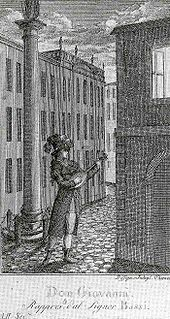
Deh, vieni alla finestra “哎, 你到窗前来”

Don Giovanni's (baritone) serenade from Act 2 of Don Giovanni (K. 527; complete title: Il dissoluto
punito, ossia il Don Giovanni, literally The Rake Punished, or Don Giovanni), an opera in two acts
with music by Wolfgang Amadeus Mozart and with an Italian libretto by Lorenzo Da Ponte.

Setup: Don Giovanni serenades Donna Elvira’s maid under her window to seduce her.

Renditions by:

Samuel Remey – http://www.youtube.com/watch?v=1-13t581Fzc

Ruggero Raimondi – http://www.youtube.com/watch?v=kZa1mEVFfhk

Dmitri Hvorostovsky -http://www.youtube.com/watch?v=t2vnjUX_Dns&feature=related


Tr. YK Chan 陳耀國译

Deh, vieni alla finestra, o mio tesoro,          哎, 我亲爱的, 你到窗前来;
Deh, vieni a consolar il pianto mio.             哎, 来安慰我的忧伤吧!
Se neghi a me di dar qualche ristoro,            假如你不慰藉我的话,
Davanti agli occhi tuoi morir vogl'io!           我就会在你眼前死去.
Tu ch'hai la bocca dolce più del miele,          你的口唇比蜜糖更甜,
Tu che il zucchero porti in mezzo al core!       你内心就带着糖般甜美.
Non esser, gioia mia, con me crudele!            我之喜爱, 那你就不要这样残忍,
Lasciati almen veder, mio bell'amore!            我的至爱, 我只求你让我一瞥你的美藐!

Là ci darem la mano 哪,给我们同拉手吧

A seductive duet sung by Zerlina (soprano) and Don Giovanni (baritone), the title role of Don Giovanni
(K. 527;complete title: Il dissoluto punito, ossia il Don Giovanni, literally The Rake Punished, or
Don Giovanni),an opera in two acts with music by Wolfgang Amadeus Mozart and with an Italian
libretto by Lorenzo Da Ponte.

In this duet, Don Giovanni targets at Zerlina (soprano, a peasant bride) in Act 1.  It is featured in the Danish film “Barbette’s Feast (1987)”.

Renditions by:

Christine Schafer & Simon Keenlyside (in concert) –

http://www.youtube.com/watch?v=ymBPo0AJ-2Y

Hei-Kyung Hong & Bryn Terfel – http://www.youtube.com/watch?v=NqPcb1nKZYg&feature=related

Renee Fleming & Dmitri Hvorostovsky (in concert) –

http://www.youtube.com/watch?v=-iZHwbxLBO0&feature=related

Dawn Upshaw & Samuel Ramey—

http://www.youtube.com/watch?v=wQ7PKtS2BR8&NR=1

Tr. YK Chan 陈耀国译

Don Giovanni
Là ci darem la mano,
Là mi dirai di si.
Vedi, non è lontano;
Partiam, ben mio, da qui. 

Zerlina
(Vorrei e non vorrei,
Mi trema un poco il cor.
Felice, è ver, sarei,
Ma può burlarmi ancor.)

Don Giovanni
Vieni, mio bel diletto!

Zerlina
(Mi fa pietà Masetto.)

Don Giovanni
Io cangierò tua sorte.

Zerlina
Presto… non son più forte.

Don Giovanni
Andiam!

Zerlina
Andiam!

A due
Andiam, andiam, mio bene.
a ristorar le pene
D’un innocente amor.

唐。吉奧凡尼
哪,给我们同手拉手吧,
哪,你就对我说”好吧”;
瞧,那並不是太遠的;
我親爱的,我们从这里走开好了。 

雪蓮娜
(我想,但又不想,
我有點兒心跳。
我会真高興,
但那也会是一种挑逗。

唐。吉奧凡尼
来, 我的可人儿!

雪蓮娜
(我怜恤马塞图)

唐。吉奧凡尼
我会改永远变你的命运

雪蓮娜
立刻…我不甚坚强

唐。吉奧凡尼

我们走吧!

雪蓮娜
我们走吧!

合唱
我们走吧, 我们走吧, 我亲爱的
去治疗那无知爱情的痛楚